
Rechercher des produits

Recherchez par technologie, fluide ou application.

01Mesure de températureCapteurs et transmetteurs de température de procédé. 02Mesure de niveauInstruments radar, ultrasons et hydrostatiques. 03Mesure de pressionInstruments de pression relative, absolue et différentielle. 04Mesure de débitTechnologies pour liquides, gaz et vapeur. 05Pièces de rechange DCSModules de contrôle, E/S, alimentation et communication. 06Analyse de la qualité de l’eauCapteurs et instruments d’analyse de l’eau. MODELChongqing Chuanyi MS22PSB2D10B0060DMZ Magnetostrictive Level GaugeEngineered for ultimate reliability and high-accuracy fluid monitoring, the MS Series Magnetostrictive Liquid Level Transmitter delivers continuous, real-time measurements for total liquid level and interface positions in demanding industrial environments. Utilizing advanced magnetostrictive sensing technology, this versatile transmitter provides precise, non-contact signal processing with a measurement accuracy up to ±1mm, making it an ideal solution for critical process controls across chemical processing, oil and gas, power generation, and water treatment applications where long-term stability and explosion-proof durability are paramount. MODELE+H FMU30 Non-Contact Ultrasonic Level TransmitterThe Prosonic FMU30 Non-Contact Ultrasonic Level Transmitter provides highly accurate, maintenance-free continuous level and open-channel flow measurement for liquids, pastes, and coarse bulk solids across municipal and industrial applications. Featuring an integrated temperature sensor for automatic sound velocity compensation, a user-friendly 4-line plain text display with 32-point linearization, and a rugged IP68-rated weatherproof enclosure, this compact 2-wire transmitter delivers dependable real-time tank monitoring, pump control, and overflow protection in sewage treatment plants, process water storage, and chemical buffer tanks. MODELE+H Deltabar PMD55B High Precision Smart Differential Pressure TransmitterThe PMD55B High Precision Smart Differential Pressure Transmitter delivers exceptionally accurate differential pressure, flow, and hydrostatic level measurements for industrial liquids, gases, and steam. Featuring a robust metallic diaphragm, ultra-low long-term drift, optional wireless Bluetooth operation, and SIL2/3 functional safety certifications, this versatile instrument provides stable, error-free process monitoring across harsh chemical, oil, and water treatment environments. MODELE+H Waterpilot FMX11 Submersible Hydrostatic Level TransmitterThe Waterpilot FMX11 is a high-precision, heavy-duty submersible hydrostatic level transmitter engineered for continuous liquid level and depth monitoring in fresh water, groundwater wells, drinking water reservoirs, and surface water bodies. Featuring an ultra-compact 22mm stainless steel 316L housing, an integrated atmospheric pressure compensation tube with a protective Teflon filter, and international drinking water certifications, this compact dip cell sensor delivers exceptional long-term stability and precise 4–20 mA signal output even in narrow 1-inch pipes and demanding environmental conditions. MODELChongqing Chuanyi WZGPK-73DH-GB/1P2-AJ150G-M20XC6-AXX-I5/2AM20 Explosion-proof RTDThe WZGPK is a heavy-duty explosion-proof armored Pt100 RTD temperature sensor engineered for accurate thermal monitoring in hazardous industrial environments. Equipped with a high-precision Class A platinum sensing element, a 3-wire connection, a 6mm diameter sheath made of durable 321 stainless steel, and a 150mm insertion length, this flameproof sensor delivers exceptionally fast thermal response, vibration resistance, and long-term stability across a wide temperature range from -200°C to 600°C. Designed with an M20x1.5 process thread and an explosion-proof junction box, it provides reliable flameproof protection and continuous signal accuracy for chemical plants, oil refineries, and automated process control systems. MODELYokogawa ADV151-P50/D5A00 Digital Input Module ExstockEngineered for reliable industrial automation, the Yokogawa ADV151-P50/D5A00 Digital Input Module provides high-density 32-channel, 24 V DC isolated signal processing alongside dedicated connection adapters, ensuring optimal signal integrity, robust noise immunity, and seamless integration into distributed control systems (DCS). MODELYokogawa AAI143-H50 Analog Input Module ExstockThe Yokogawa AAI143-H50 is a high-performance 16-channel isolated analog input module designed for process automation systems, capable of handling 4 to 20 mA standard signal inputs with exceptional stability and accuracy. Supplied with its matching terminal block adapter, this module offers seamless integration, superior noise immunity, and reliable data acquisition for demanding industrial environments. MODELYokogawa S2CP471-01 Controller Module Spare Part ExstockThe Yokogawa S2CP471-01 Controller Module Spare Part provides reliable, real-time control performance and high-speed VNET/IP communication connectivity to optimize your industrial DCS automation system with seamless integration and reduced operational downtime. MODELChongqing Chuanyi PDS843MH-1CS11-D1DA Differential Pressure TransmitterThe PDS843 Smart Differential Pressure Transmitter is a high-performance industrial instrument engineered with advanced monocrystalline silicon composite sensor technology, delivering an exceptional accuracy of up to ±0.025% FS and long-term stability of ≤±0.1% FS over 10 years. Designed for rigorous process automation, it seamlessly measures differential pressure, flow, and liquid level across harsh environments in chemical processing, oil and gas, power generation, and water treatment plants. Supporting HART 7.0, PROFIBUS-PA, and FOUNDATION Fieldbus protocols along with global explosion-proof certifications (ATEX, IECEx, NEPSI, EAC, SIL2/3), the PDS843 provides reliable realtime diagnostics, local three-button LCD configuration, and robust surge protection to optimize your industrial control systems. MODELE+H Prosonic Flow W 400 Non-Invasive Clamp-On Ultrasonic Flow MeterThe Prosonic Flow W 400 is an advanced, non-invasive clamp-on ultrasonic flow meter engineered for precise, maintenance-free measurement of both conductive and non-conductive liquids. Designed with innovative FlowDC (Flow Disturbance Compensation) technology, the W 400 maintains high-precision performance even with restricted straight inlet runs as short as 2 x DN.Flexible measurement across nominal pipe diameters from DN15 to DN4000 (1/2" to 160"). MODELE+H Memosens CPS11E Industrial Digital pH Sensor & TransmitterOur Digital Glass pH Sensor is an industrial-grade, heavy-duty solution engineered for reliable pH measurement in challenging process conditions and environmental monitoring. Utilizing advanced Memosens digital non-contact signal technology, it completely eliminates signal interference caused by moisture, corrosion, and cable length issues.Equipped with a dirt-repellent PTFE ring diaphragm and integrated NTC 30K temperature sensor, this sensor delivers long-term stability, minimal maintenance, and plug-and-play pre-calibrated convenience for global system integrators and industrial plants. MODELE+H Prosonic FMU42 Non-Contact Ultrasonic Level TransmitterThe Prosonic FMU42 is a high-precision, non-contact ultrasonic level transmitter designed for continuous level measurement of liquids, pastes, and coarse solids, as well as accurate flow rate measurement in open channels and weir systems across demanding industrial environments. SOLUTIONSurveillance intelligente du réseau d'eauCombinez les données vérifiées de débit et de pression pour la surveillance de la distribution et l’examen opérationnel. SOLUTIONMesure de la pression de l'hydrogèneExaminez les matériaux, la plage de pression et les exigences de sécurité pour la mesure du procédé à l'hydrogène. SOLUTIONSélection de mesure de processusCommencez par le support, la fenêtre de fonctionnement, l'installation et le signal requis avant de sélectionner un instrument.

Yokogawa CENTUM VP DCS vs. ProSafe-RS SIS: Architectural Comparison, Co-Engineering, and Hardware Selection Guide

Yokogawa CENTUM VP DCS vs. ProSafe-RS SIS: Architectural Comparison, Co-Engineering, and Hardware Selection Guide
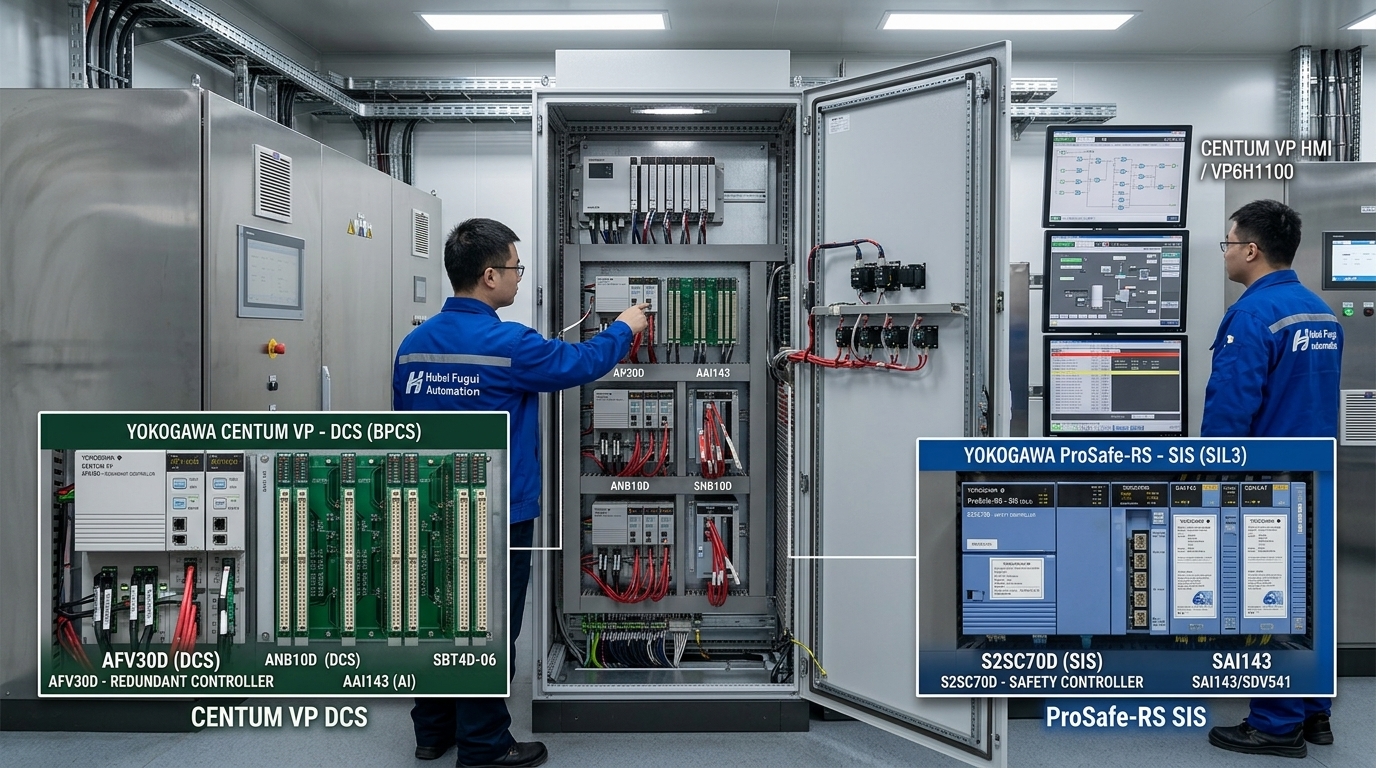
Yokogawa CENTUM VP DCS AFV30D controller cabinet alongside ProSafe-RS SIS S2SC70D safety system with HMI monitoring screens

In process automation, specifying hardware architecture for continuous processing units—such as ethylene cracker plants, LNG regasification terminals, and offshore production platforms—demands a clear separation of operational objectives. Process control and process safety serve fundamentally opposing paradigms. Process control optimizes operating points to maximize yield and efficiency, whereas safety instrumentation prevents catastrophic loss of containment, equipment damage, and human injury.

Yokogawa Electric Corporation addresses these two domains through its flagship platforms: the CENTUM VP Distributed Control System (DCS) and the ProSafe-RS Safety Instrumented System (SIS). Although both platforms share aesthetic components and direct software integration paths, their internal physical designs, fault-tolerant execution engines, and qualification levels diverge substantially.

Executive Selection Summary

Never substitute DCS hardware for Safety Instrumented Functions (SIFs) requiring Safety Integrity Level 2 (SIL2) or Safety Integrity Level 3 (SIL3). While CENTUM VP controller units (e.g., AFV30D) deliver high availability through pair-and-spare redundancy, only ProSafe-RS controllers (e.g., S2SC70D) possess certified self-diagnostics capable of executing safety logic under IEC 61508 / IEC 61511 mandates.

1. Fundamental Operational Paradigms: Control vs. Safety

To establish a selection baseline, automation engineers must evaluate the operational posture of each system under normal and fault conditions:

  • CENTUM VP (Distributed Control System): Designed to keep process parameters within active operating envelopes. The priority is high availability and process continuity. If an I/O card or controller processor experiences a transient hardware fault, the DCS is engineered to fail-over seamlessly without tripping the plant.
  • ProSafe-RS (Safety Instrumented System): Designed to monitor the process for hazardous deviations and drive the process to a predefined “safe state” (typically de-energize to trip) upon detecting abnormal limits or internal subsystem failures. The priority is fail-safe integrity and diagnostic coverage.

2. Hardware Architecture & Diagnostics

The architectural distinction between CENTUM VP and ProSafe-RS lies in the execution pipeline within the Central Processing Units (CPUs) and the I/O bus interface modules.

CENTUM VP Pair-and-Spare Architecture

The core field control unit of CENTUM VP (such as the AFV30D Dedicated Controller Unit) utilizes a Pair-and-Spare microprocessor arrangement. Each controller housing contains two processing cards, and each card integrates two MPU cores running identical software instructions in tight lock-step synchronization.

If a hardware disagreement occurs between the primary pair, control transfers instantly to the secondary pair within a fraction of a millisecond, preventing process disturbance. This design guarantees high operational uptime, but it is optimized for continuous control rather than SIL-rated safety shutoff verification.

ProSafe-RS Dual Electronic Architecture

In contrast, the ProSafe-RS Safety Control Unit (such as the S2SC70D Safety Controller Unit) implements a single-module, dual-processor arrangement certified up to SIL3 according to IEC 61508. The system executes dual redundant calculations while performing active background diagnostic checks on internal memory registers, field loop wiring integrity, and internal clock frequencies.

Hardware Comparison: Processor & I/O Module Architecture

CENTUM VP Controller: AFV30D-A41452 (24V DC) / AFV30D-A41252 (220V AC)
- Redundancy Model: Pair-and-Spare (High Availability Focus)
- Standard I/O Cards: AAI143 (16-Ch AI 4-20mA), AAI543 (16-Ch AO), ADV151 (32-Ch DI)

ProSafe-RS Controller: S2SC70D-SA14010 (24V DC) / S2SC70D-SA12010 (220V AC)
- Redundancy Model: Dual-Processor with Advanced Self-Diagnostics (Fail-Safe Focus)
- Safety I/O Cards: SAI143 (Safety AI), SAI533 (Safety AO), SDV144 (Safety DI), SDV541 (Safety DO)
    

3. Deep Comparison Matrix: CENTUM VP vs. ProSafe-RS

Architecture Dimension CENTUM VP DCS System ProSafe-RS SIS System
Primary Application Continuous Control, Regulatory Control, Batching, Data Logging Emergency Shutdown (ESD), Fire & Gas (F&G), Burner Management (BMS)
Safety Certification Basic Process Control System (BPCS) per IEC 61511 TÜV Certified up to SIL3 (Single Controller) per IEC 61508
Fail State Policy Maintain operation via bumpfree redundant switchover De-energize to trip / Fail-safe state upon unrecoverable error
Main Processing Units AFV30D-A41452 / AFV30D-A41252 S2SC70D-SA14010 / S2SC70D-SA12010
I/O Expansion Nodes ANB10D-445 / ANB10D-425 Terminal & Intermediate Nodes SNB10D-445 / SNB10D-425 Safety Local Node Units
Bus Infrastructure ESB Bus (ANT401 / ANT501, YCB301 Cables) Safety ESB Bus (SNT401 / SNT501, SEC401 Cards)
Environmental Protection Optional G3 Conformal Coating (/K4A00 /D5A00) Standard Conformal Coating for harsh environments
Software Suite VP6 Engineering Suite (VP6E51AD, VP6H1100 HMI) ProSafe-RS Engineering Software / CENTUM Integrated HMI

4. Engineering Co-Integration: “One Architecture” Concept

Historically, integrating a DCS from one vendor and a SIS from another required complex Modbus RS-485 interfaces, custom memory mapping, and separate operator consoles. Yokogawa eliminated this operational friction through seamless hardware and software co-integration.

Integrated Control and Safety System (ICSS)

ProSafe-RS connects directly to the same Vnet/IP control network utilized by CENTUM VP. Consequently, process alarms, safety interlock statuses, and diagnostic alerts from ProSafe-RS natively pass to the CENTUM VP Human Machine Interface (HMI) package (e.g., VP6H1100-V11N01) without requiring gateway programming.

  • Unified Alarm Management: Process operators view DCS operational alarms and SIS safety trips on a single integrated alarm summary display, adhering to ISA-18.2 standards.
  • Time Synchronization: Sequence of Events (SOE) recorders across both AFV30D control units and S2SC70D safety control units are synchronized to within 1 millisecond via Vnet/IP, enabling root-cause analysis following process trips.
  • Consolidated Software Maintenance: System administrators manage maintenance contracts and software updates through standardized frameworks like the SV2CPML-V1103 (DCS Annual Maintenance) and SS2CPMLM-V1103 (SIS Annual Maintenance) licenses.

5. Module Selection & Hardware Bill of Materials (BOM) Guidelines

When engineering field control panels or expanding existing cabinet footprints (such as standard Rittal 800×800×2105 mm enclosures), specifying the correct combination of node units, cards, and cabling is vital.

DCS Analog & Digital Module Selection Rules

  1. Harsh Environment Protection: For chemical plants containing corrosive airborne gases (sulfur dioxide, hydrogen sulfide), specify modules with G3 Conformal Coating. Use part suffix extensions like AAI143-H50/K4A00 G3 or ADV151-P60/D5A00 G3.
  2. Signal Isolation: Ensure transmitter input loops employ 16-channel isolated cards (e.g., AAI143 for 4-20mA inputs and AAI543 for outputs) combined with Pepperl+Fuchs dedicated isolators (e.g., HIC2025 or HIC2031) or intrinsic safety barrier terminal boards (e.g., HICTB16-YC3-RRB-KS-CC-A016).
  3. Node Termination: When configuring remote expansion racks via ESB bus, place terminal node units (ANB10D-445-CU2T) at the end of the chain, while intermediate nodes (ANB10D-445-CU2N) link daisy-chained positions. Interconnect nodes using high-grade bus cables like YCB301-C100 or YCB301-C200.

SIS Safety Module Selection Rules

  1. Dedicated Safety I/O: Never wire trip signal inputs (e.g., High-High pressure switches, ESD pushbuttons) to standard DCS ADV151 or AAI143 cards. Use dedicated ProSafe-RS safety cards: SAI143-H63 for safety analog inputs, SDV144-S63 for safety digital inputs, and SDV541-S63 for safety digital outputs.
  2. Safety Relay Interfacing: Route high-power trip signals through dedicated safety relay output boards like the SRM540-000 or SBD4D-06 to maintain galvanically isolated fail-safe loops.

6. Procurement & Life-Cycle Spare Parts Planning

Unplanned plant downtime costs continuous process facilities tens of thousands of dollars per hour. Maintaining a strategic spare parts inventory mitigates long lead-time supply chain disruptions during turnarounds or emergency outages.

Recommended Critical Spares On-Site Inventory

For a standard 2,000-point ICSS system, maintain at least one hot-swappable processor spare (DCS: CP471-00 or CP461-50; SIS: S2CP471-01), two power supply units (DCS: PW484-50; SIS: SPW484-53), and a 10% inventory buffer of high-density I/O modules with pre-installed connection headers (e.g., SBT4D-06).

Technical Consultancy & Supply Chain Support

This technical whitepaper is authored by the Instrumentation & Automation Engineering Division at Hubei Fugui Automation Technology Co., Ltd. We specialize in factory-sealed, 100% pre-tested Yokogawa CENTUM VP and ProSafe-RS hardware, software licenses (VP6 Series), and emergency replacement modules.

For factory test reports, conformal coating verification (/K4A00), or technical datasheets, reach out to our engineering team at robin@baoboindustry.com or call +86-18827058766.