
Introduction: Why Industrial Procurement Is an Engineering Decision
In a continuously operating process plant, a purchasing decision can have consequences far beyond the purchase order itself.
An analog input module that cannot communicate correctly with the installed control system may delay a scheduled shutdown. A pressure transmitter with an unsuitable measuring range can compromise control-loop performance. An incorrectly specified flowmeter may produce unreliable readings, affecting process optimization, water management or production reporting.
These problems are not necessarily caused by poor equipment. In many cases, they begin with incomplete specifications, insufficient compatibility checks or a purchasing process that gives too much weight to unit price.
For industrial facilities across Southeast Asia, these risks deserve particular attention. The region includes semiconductor manufacturing, palm oil processing, petrochemical production, power generation, food processing, water treatment and a wide range of industrial infrastructure projects. Each sector has different operating requirements, but all depend on accurate measurement and reliable automation.
Procurement teams must therefore balance several objectives:
- Obtain the correct instrument or spare part for the installed application.
- Minimize unplanned downtime and avoidable maintenance expenditure.
- Confirm product condition, traceability and relevant documentation.
- Control international shipping costs and delivery uncertainty.
- Maintain compatibility with existing control systems and field installations.
- Avoid unnecessary inventory while protecting against critical spare-part shortages.
The most effective procurement strategy is not simply to find the cheapest supplier. It is to establish a repeatable process for selecting, verifying and obtaining equipment that meets the plant’s actual requirements.
This guide explains how engineering and procurement teams can apply that approach when sourcing industrial instrumentation and distributed control system (DCS) spare parts in Southeast Asia.
1. Understand the Operating Environment Before Selecting Equipment
Industrial instrumentation should be selected according to the process, installation and maintenance environment—not merely the instrument category.
Humidity, temperature and enclosure protection
Plants in Singapore, Malaysia, Thailand, Vietnam, Indonesia and the Philippines may experience high humidity, heavy rainfall, elevated ambient temperatures and frequent temperature changes.
These conditions can contribute to condensation, corrosion and deterioration of electrical connections, particularly where enclosure sealing, cable entry or maintenance practices are inadequate.
An instrument’s ingress protection rating is relevant, but it does not independently establish suitability for every installation. Engineers should also evaluate enclosure installation, cable glands, electrical connections, ambient temperature limits and exposure to washdown or corrosive atmospheres.
For equipment installed outdoors, the specification should reflect the actual environmental conditions and applicable project requirements.
Corrosion and process compatibility
Chemical processing, wastewater treatment, palm oil production and other industrial applications may involve corrosive liquids, suspended solids, cleaning chemicals or fluctuating process temperatures.
The wetted materials of a transmitter or flowmeter must be compatible with the process medium under the intended operating conditions.
For example, selecting a pressure transmitter requires consideration of the diaphragm material, process connection, seals and any required chemical compatibility. A stainless-steel housing alone does not guarantee that all wetted components are suitable for a particular chemical.
Where the process is aggressive or hazardous, the engineering team should verify the manufacturer’s material compatibility guidance before placing an order.
Vibration, electrical noise and installation quality
Pumps, compressors, motors and heavy rotating machinery can introduce vibration and electrical interference. These conditions may affect the reliability of instrumentation signals if the equipment, cabling and installation are not properly specified.
When troubleshooting an unstable measurement, engineers should consider the complete measurement loop: the sensor, transmitter, power supply, cable, grounding arrangement, input module and control-system configuration.
Replacing the transmitter without investigating the rest of the loop may leave the underlying problem unresolved.
For plants with recurring instrumentation failures, a structured review of environmental exposure, installation quality and maintenance history can be more useful than repeatedly replacing individual components.
2. Yokogawa DCS Spare Parts: Compatibility Comes Before Price
DCS hardware is a particularly important procurement category because the function of an individual module depends on its position within a larger control architecture.
Yokogawa systems are used in process automation applications where reliable signal acquisition, controller operation and communication between system components are essential. However, a module should never be assumed interchangeable simply because its manufacturer or product family matches the installed system.
Start with the complete model number
Before requesting a quotation for a Yokogawa DCS card or module, record the complete model designation from the equipment label.
Include applicable suffixes, hardware revisions, associated adapters and terminal assemblies. Where possible, provide a clear photograph of the nameplate and identify the installed DCS platform.
A partial model number may identify a product family without establishing that a particular configuration is suitable for the application.
For maintenance teams sourcing replacement hardware, FUGUI Automation provides a dedicated Yokogawa DCS spare parts and modules product category.
Understand the difference between module functions
DCS modules perform distinct functions, and their electrical interfaces can differ substantially.
An analog input module receives continuous signals from field instruments. A digital input module monitors discrete conditions such as switch states. Output modules transmit control commands, while controller and communication modules perform other functions within the automation architecture.
Consider two examples:
- The Yokogawa AAI143-H50 analog input module is listed for isolated analog input and 4–20 mA signals.
- The Yokogawa ADV151-P50/D5A00 digital input module is listed as a 32-channel digital input module for 24 V DC signals.
These products serve different signal-acquisition requirements. Their differences illustrate why a purchasing engineer should verify function, signal characteristics, channel arrangement and connection hardware before accepting a replacement.
The exact configuration and suitability for the installed system must be checked against the relevant manufacturer documentation.
Check the complete installation, not just the module
A technically sound replacement review should cover:
- The installed DCS platform and system generation.
- The full module model and relevant hardware revision.
- Signal type, electrical characteristics and channel configuration.
- Required terminal blocks, adapters and mounting arrangements.
- Firmware, software or configuration dependencies where applicable.
- Manufacturer documentation and any project-specific approval requirements.
For an existing plant, the approved system drawings and configuration records should take precedence over assumptions based on a product description.
Where compatibility cannot be established from the available information, obtain a technical review before ordering.
Verify stock, condition and traceability
Urgent maintenance requirements often lead buyers to prioritize immediate availability. That is understandable, but stock status is only one part of supplier qualification.
Ask the supplier to confirm whether the specific item is physically available, whether the quoted model matches the requirement, what documentation accompanies the unit and what warranty applies.
Where appropriate, request photographs of the actual stock, the nameplate, packaging and available inspection or traceability records.
A quotation should distinguish confirmed facts from details that remain subject to verification. This is especially important for legacy automation systems, where the consequences of receiving an unsuitable module can exceed the value of the component itself.
3. Selecting Process Instruments for Real Operating Conditions
Field instrumentation requires a similarly disciplined approach. The correct instrument depends on the measured variable, process medium, operating range, installation conditions and interface to the control system.
Pressure transmitters: Define the measurement before choosing the model
Pressure measurement is common in chemical processing, utilities, water treatment and energy applications.
Before sourcing a pressure transmitter, establish whether the application requires gauge pressure, absolute pressure or differential pressure measurement.
The calibrated range should reflect normal operation and credible operating extremes. An unnecessarily wide range can reduce the usefulness of the measurement, while an unsuitable range can expose the instrument to conditions outside its intended operating envelope.
The specification should also identify:
- Normal and maximum operating pressure.
- Process temperature.
- Wetted materials and process connection.
- Required accuracy and stability.
- Output signal and communication protocol.
- Hazardous-area classification, if applicable.
- Environmental protection and documentation requirements.
For differential pressure applications, clarify whether the instrument is measuring filter differential pressure, flow, liquid level or another variable. The application determines which additional design considerations matter.
Engineers can review the available industrial pressure measurement products when developing a sourcing specification.
Flowmeters: Match the measuring principle to the medium
Flow measurement is often more complex than choosing a meter by pipe diameter.
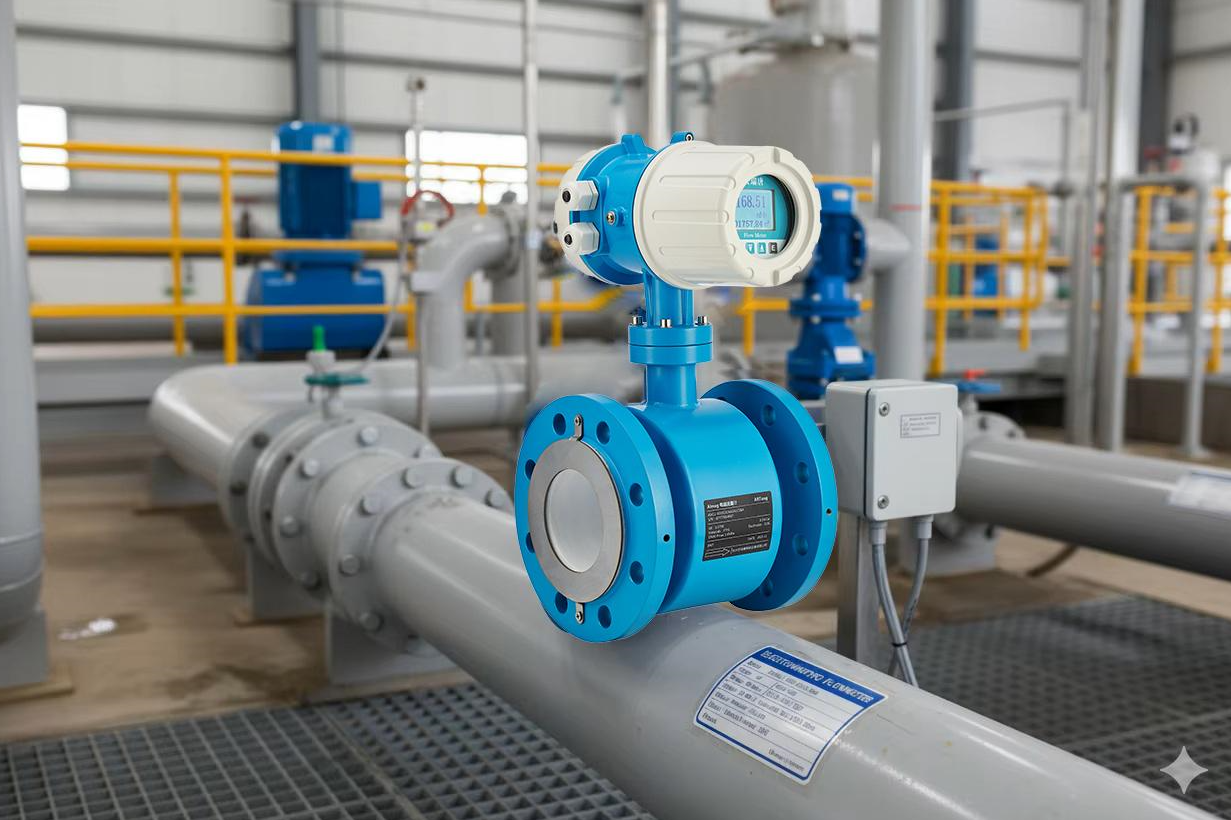
Electromagnetic flowmeters are commonly considered for electrically conductive liquids. Ultrasonic flowmeters may suit certain applications where non-invasive installation is advantageous. Vortex meters are used in appropriate liquid, gas and steam applications, while Coriolis meters can provide direct mass-flow measurement.
Each technology has limitations, so the selection should reflect the actual process.
For an electromagnetic flowmeter, important considerations include liquid conductivity, pipe condition, liner and electrode materials, flow range, installation orientation and the manufacturer’s requirements for a full pipe.
For an ultrasonic flowmeter, the engineer should consider the liquid properties, pipe material, wall thickness, installation access and available straight-run conditions. Clamp-on technology can be useful where cutting into a process line is undesirable, but its suitability must be established for the actual installation.
A flowmeter procurement specification should therefore include the medium, nominal pipe diameter, expected minimum and maximum flow, process pressure, temperature, connection requirements and required output.
The industrial flow measurement product range provides a starting point for evaluating relevant technologies and product options.
Level measurement: Account for tank geometry and process behaviour
Level measurement is influenced by more than the liquid or solid being measured.
Tank geometry, internal obstructions, foam, vapour, dust, turbulence and changing dielectric properties can all influence instrument performance, depending on the measuring principle.
Radar, ultrasonic and hydrostatic methods have different operating characteristics. A solution that performs well in a clean water tank may not be suitable for a vessel containing heavy vapour, irregular solids or a chemically aggressive medium.
When requesting a level transmitter quotation, provide the vessel dimensions, measuring range, medium, operating temperature and pressure, installation location and any relevant process disturbances.
Where possible, include a drawing or photograph showing the proposed mounting position.
Review the available industrial level measurement instruments against the actual installation requirements rather than selecting a device solely from its advertised measuring range.
Temperature measurement: Consider response time and sensor construction
Temperature sensors are widely used in boilers, heat exchangers, chemical reactors, production lines and utility systems.
The selection process should distinguish between thermocouples, resistance temperature detectors (RTDs) and other temperature-sensing technologies.
The appropriate sensor depends on the temperature range, required accuracy, response time, vibration, immersion depth, sheath material and process connection.
For an RTD installation, the engineer should verify the sensing element, wiring arrangement, transmitter compatibility and required accuracy class. For high-temperature or hazardous-area applications, the construction and certification requirements need additional attention.
The temperature measurement product range can help buyers identify candidate products before final technical approval.
Water quality analysis: Define the parameter and sampling conditions
Water treatment and industrial wastewater applications may require continuous monitoring of pH, conductivity, dissolved oxygen, turbidity or other water quality parameters.
Selecting a suitable analyzer requires more than identifying the parameter. Engineers should consider the sample composition, expected measurement range, temperature, cleaning requirements, installation arrangement, calibration procedure and maintenance access.
In wastewater applications, suspended solids, fouling and variable sample conditions can affect sensor maintenance and measurement reliability.
The procurement specification should identify the required parameter, measurement range, process connection or sampling arrangement, output interface and relevant project standards.
Explore the industrial water quality analysis product category for instrumentation used in water monitoring and treatment applications.
4. The Procurement Checklist: What to Include in an RFQ
An effective request for quotation (RFQ) allows the supplier to evaluate the requirement without repeatedly asking for missing information.
For a standard field instrument, the initial inquiry should include:
Product identification
- Manufacturer and complete model number, if known.
- Equipment tag and intended application.
- Required quantity.
- Exact replacement or new-project requirement.
Technical requirements
- Measured variable and process medium.
- Normal and maximum operating conditions.
- Measuring range and required performance.
- Wetted materials and process connection.
- Output signal and communication protocol.
- Environmental and hazardous-area requirements.
Commercial requirements
- Delivery destination and target date.
- Required documentation and certifications.
- Warranty expectations.
- Shipping preference and applicable delivery terms.
- Any project-specific inspection or acceptance requirements.
For DCS spare parts, add the system platform, full module designation, applicable revision and required adapters or terminal assemblies.
For an EPC project, include the relevant datasheet, instrument index, bill of materials and project specification wherever available.
The goal is not to create unnecessary paperwork. It is to reduce the risk of receiving a quotation that is commercially attractive but technically incomplete.
Ask suppliers to identify deviations clearly
If a requested model is unavailable, a proposed alternative should be identified as an alternative—not presented as an automatically interchangeable replacement.
The supplier should explain the differences and provide relevant documentation for engineering review. The buyer’s authorized engineer should approve any substitution before the purchase order is released.
This distinction is particularly important for control-system modules, safety-related equipment, hazardous-area instruments and applications governed by strict project specifications.
5. Total Cost of Ownership: Why the Lowest Unit Price May Not Be the Best Deal
Industrial procurement teams often compare quotations using the unit price as the primary decision factor. For non-critical items, this may be adequate. For important instrumentation and automation hardware, a broader evaluation is more useful.
The total cost of a procurement decision can include:
- Purchase price.
- International freight and insurance.
- Customs clearance and applicable duties or taxes.
- Inspection and documentation costs.
- Installation and commissioning labour.
- Engineering time spent resolving compatibility issues.
- Potential production losses associated with delays or incorrect equipment.
Consider two hypothetical quotations for the same approved requirement.
Supplier A offers a lower price but cannot confirm stock or provide a reliable dispatch estimate. Supplier B offers a higher price and confirms the model, available documentation and shipment schedule.
The lower-priced quotation may still be the better option if its delivery risk is acceptable. Conversely, if the component is required for a fixed shutdown, a verifiable delivery commitment may justify the higher cost.
The correct decision depends on the operational consequences, technical suitability and total expected cost—not a universal preference for either the cheapest or fastest supplier.
Evaluate suppliers using consistent criteria
A practical supplier comparison can include five categories:
| Evaluation criterion | What the buyer should verify |
|---|---|
| Technical suitability | Model, configuration, interfaces and application requirements |
| Availability | Confirmed stock status and realistic dispatch date |
| Documentation | Required datasheets, certificates and traceability records |
| Commercial terms | Price, warranty, freight and payment terms |
| Communication | Clear answers, transparent limitations and timely follow-up |
For critical items, technical suitability should be a mandatory condition rather than a score that can be offset by a low price.
6. Building a More Resilient MRO Spare Parts Strategy
Maintenance, repair and operations (MRO) procurement is most effective when the plant prepares for foreseeable equipment failures before they occur.
Classify spare parts by operational criticality
Not every instrument requires an identical inventory strategy.
A useful classification considers the consequences of failure, failure probability, redundancy, repair time, replacement lead time and the availability of approved alternatives.
A common temperature indicator may be easy to replace and readily available. A specific legacy DCS communication module may be much harder to source and could have a greater operational impact.
For critical automation hardware, retaining a verified spare may be justified even if the unit is rarely used. The decision should be based on a documented risk assessment rather than purchasing history alone.
Maintain an accurate installed-equipment register
The register should include the equipment tag, manufacturer, full model number, location, system association, configuration, maintenance history and supplier information.
For DCS components, record the system generation, hardware revision and associated connection hardware where relevant.
This information becomes especially valuable during plant shutdowns, staff transitions, emergency repairs and projects involving older equipment.
Review inventory after changes and failures
Spare-part requirements can change when equipment is modified, production capacity expands or control-system architecture is upgraded.
Review the critical-spares list after major maintenance activities, recurring failures, system changes and changes in supplier lead times.
Where a component becomes obsolete, document an approved replacement strategy. Do not assume that a newer product is compatible simply because it has a similar function.
Establish a clear emergency procurement process
An emergency RFQ should communicate the problem, the required component, the operational deadline and the destination.
A concise inquiry containing the full model number, nameplate photograph, required quantity and delivery location is often more actionable than a lengthy message without identifying information.
The maintenance team should also identify who is authorized to approve substitutions and who will verify the replacement before installation.
This reduces delays during time-sensitive maintenance events.
7. Sourcing Industrial Instrumentation Across Southeast Asia
International procurement adds logistical and administrative considerations to technical selection.
A supplier may have a suitable product, but the buyer still needs to establish stock availability, delivery arrangements, documentation requirements and the terms under which the order will be supplied.
Singapore and Malaysia
For facilities with established engineering and procurement processes, a well-prepared RFQ can simplify technical review and supplier comparison.
Buyers should clearly identify project specifications, required documentation, delivery locations and any site-specific acceptance requirements.
For plants operating legacy control systems, exact model identification and compatibility review remain important regardless of the supplier’s location.
Thailand, Vietnam and Indonesia
Manufacturing, utilities, chemical processing and water infrastructure projects may involve a combination of new equipment procurement and maintenance of installed systems.
When sourcing instrumentation internationally, buyers should clarify import documentation, delivery responsibilities and any applicable local project requirements before placing an order.
For process instruments, operating conditions and connection details should be established early enough to avoid selecting a model that requires unplanned modifications at site.
The Philippines and other regional markets
For remote facilities or sites with limited local stock, lead time and shipment planning may be especially important.
The procurement team should confirm whether an item is physically available, the expected dispatch date, the proposed shipping method and the documentation needed by the receiving organization.
A realistic delivery plan should include the time required for any technical approval, payment processing, export preparation and import clearance.
These steps help distinguish a genuinely actionable offer from a quotation that only confirms a nominal product price.
8. What to Look for in an Industrial Instrumentation Supplier
A reliable supplier should be able to explain what is being offered, what has been verified and what still requires customer confirmation.
For a standard instrument, this means identifying the proposed model and configuration and supplying relevant technical information.
For a DCS replacement module, it means taking the installed platform and associated hardware into account rather than relying on a broad compatibility claim.
For an urgent spare part, it means distinguishing physical stock from expected availability and communicating realistic dispatch arrangements.
FUGUI Automation supplies industrial process instrumentation and automation spare parts across product categories that include Yokogawa, Endress+Hauser and Chongqing Chuanyi products, among others.
Its product portfolio covers pressure, temperature, level, flow and water quality measurement, alongside DCS spare parts.
For buyers who already have a model number, equipment label or instrument datasheet, the most efficient starting point is a technical inquiry based on that information.
For new projects, the inquiry should instead describe the process conditions and performance requirements so that suitable options can be evaluated.
A useful quotation should answer four questions:
- What exact product and configuration are being offered?
- Which technical requirements have been verified?
- What documentation and warranty are available?
- What are the confirmed commercial terms and expected delivery arrangements?
If any of these questions remains unresolved, the buyer should clarify the point before approving the purchase.
9. A Practical Workflow for Your Next Instrumentation Purchase
The following workflow can be applied to both urgent MRO requirements and planned EPC procurement.
Step 1: Define the requirement. Identify the equipment tag, measured variable, process conditions and required quantity.
Step 2: Confirm the model or develop the specification. For a replacement, use the complete nameplate information. For a new installation, establish the operating conditions and performance requirements.
Step 3: Prepare the RFQ package. Include technical documents, required certifications, delivery destination and deadline.
Step 4: Obtain and review quotations. Compare technical suitability, documentation, stock status, warranty, total cost and delivery commitments.
Step 5: Resolve deviations. Have the responsible engineer review proposed alternatives before purchase approval.
Step 6: Verify the delivered equipment. Check the model, quantity, condition, documentation and applicable acceptance criteria.
Step 7: Update the equipment register. Record the supplier, purchase details, installation information and relevant maintenance history.
This workflow is intentionally straightforward. Its value lies in applying the same controls consistently, including when a purchase must be completed quickly.
Conclusion: Better Procurement Starts With Better Technical Information
For industrial plants across Southeast Asia, reliable instrumentation procurement is a combination of engineering discipline, supplier verification and practical logistics planning.
The most important decisions occur before the purchase order is issued: identifying the actual requirement, confirming compatibility, specifying the operating conditions and establishing what evidence is needed to accept the supplied equipment.
For Yokogawa DCS spare parts, the complete model number, system configuration and associated connection hardware are central to replacement verification.
For process instruments, the measured variable, medium, operating range, installation environment and output requirements determine whether a product is suitable for its intended role.
For international MRO purchasing, stock confirmation, documentation, delivery arrangements and total cost should be assessed alongside the quoted price.
A disciplined procurement process cannot eliminate every equipment failure or shipping delay. It can, however, reduce avoidable errors, improve supplier communication and help maintenance teams make better-informed decisions under time pressure.
When preparing your next instrumentation inquiry, begin with the complete model number or technical datasheet, define the required delivery date and identify any mandatory documentation. These simple steps give both the engineering team and supplier a stronger basis for making the right decision.
Need a Quotation for Industrial Instrumentation or DCS Spare Parts?
FUGUI Automation welcomes inquiries from maintenance teams, EPC contractors, system integrators and industrial procurement departments.
To help assess your requirement, provide the manufacturer, full model number, quantity, destination country and target delivery date. For new installations, include the process medium, measuring range, operating conditions and required output.
Request a Quotation from FUGUI Automation
Technical note: Final product selection, hazardous-area suitability, certifications and DCS compatibility must be verified against the applicable manufacturer documentation, installed system configuration and project requirements. Product availability and delivery schedules should be confirmed at the time of quotation.