
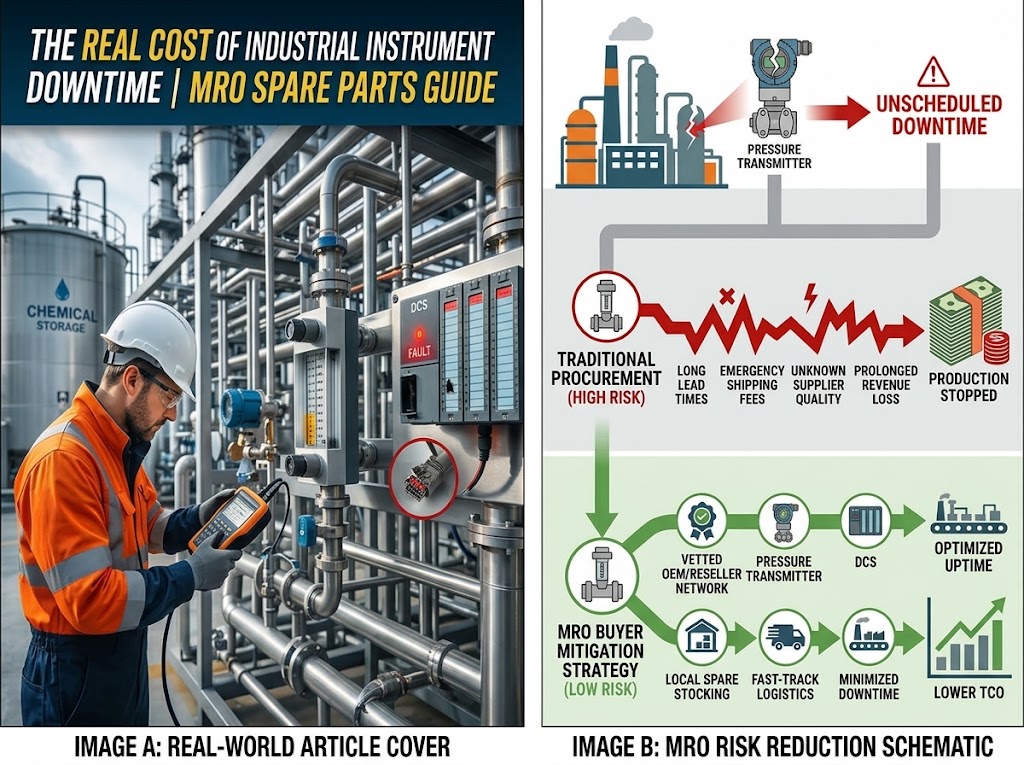
Introduction: The Cheapest Spare Part Can Become the Most Expensive Purchase
A failed industrial instrument rarely looks expensive when the purchasing request first arrives.
A pressure transmitter has failed.
A DCS input card has stopped communicating.
A flow meter is producing unstable readings.
A level transmitter needs to be replaced before the next production cycle.
The purchasing department receives a short request from maintenance:
“Please quote one replacement.”
The obvious response is to compare prices.
Supplier A offers $780.
Supplier B offers $690.
Supplier C offers $610.
At first glance, Supplier C appears to be the best option.
But this is where industrial MRO procurement becomes different from ordinary purchasing.
The price of the instrument is only one part of the cost.
The real cost may include engineering review, compatibility verification, installation modification, commissioning, freight, production interruption, emergency labor and the risk of another failure.
For a plant operating continuously, the difference between a $600 instrument and a $900 instrument may be insignificant compared with several hours of production downtime.
This is why experienced maintenance and procurement teams increasingly evaluate industrial automation spare parts according to total procurement risk, not simply unit price.
For buyers sourcing industrial instrumentation and automation products, this distinction is especially important when purchasing DCS modules, pressure transmitters, electromagnetic flowmeters, ultrasonic level transmitters and other process measurement equipment.
1. What Does an Instrument Failure Really Cost?
Consider a simple example.
A process transmitter fails at 10:30 on a Tuesday morning.
The replacement instrument costs $1,000.
If the supplier has the exact part in stock and the plant has a trained maintenance team, the instrument might be replaced within a few hours.
But suppose the situation is different.
The exact model is unavailable.
The buyer chooses an alternative.
Engineering needs to verify compatibility.
The new instrument requires a different process connection.
An adapter has to be fabricated.
The DCS configuration needs modification.
The commissioning engineer discovers that the signal configuration is different.
The production line remains partially restricted.
The instrument eventually works, but the actual cost is now several times the original purchase price.
This is why MRO procurement should begin with a different question:
What is the cost of getting the wrong part?
Not:
What is the cheapest available part?
2. Not All “Equivalent” Products Are Actually Equivalent
The word “equivalent” creates significant confusion in industrial procurement.
Two pressure transmitters may both provide 4–20 mA output.
That does not automatically make them interchangeable.
They may differ in:
- pressure range;
- accuracy;
- process connection;
- wetted materials;
- power supply;
- communication protocol;
- hazardous-area certification;
- housing;
- temperature rating;
- mounting dimensions;
- display configuration;
- calibration;
- DCS compatibility.
The same problem occurs with flowmeters.
A DN150 flow meter may physically fit the pipeline, but the measurement principle, lining, electrode material, grounding arrangement, signal configuration or communication protocol may not match the existing installation.
The same principle applies to DCS modules.
A buyer searching for a “Yokogawa analog input card” is not yet describing a complete procurement requirement.
The exact part number, system generation, revision, terminal arrangement and configuration may determine whether the module is suitable.
For example, the Yokogawa AAI143-H50 Analog Input Module is described as a 16-channel isolated analog input module for 4–20 mA signals. For an MRO buyer, however, the important question is not simply whether the card is an analog input module. The important question is whether the exact module matches the existing DCS installation and field interface.
That distinction can prevent an expensive procurement mistake.
3. DCS Spare Parts Require a Different Procurement Mindset
Process instruments can sometimes be replaced with an approved alternative.
DCS hardware is often less flexible.
A failed DCS module can affect dozens of field signals simultaneously.
Imagine a 16-channel analog input card supporting critical pressure, flow and temperature signals.
If that module fails, the problem is no longer one failed measurement.
Multiple control loops may become unavailable.
This is why DCS spare-parts procurement should be treated as production-risk management.
A plant should know:
- Which DCS platform is installed?
- Which system generation is being used?
- What is the exact module part number?
- What revision is required?
- What terminal or connection arrangement is installed?
- Is the replacement new, surplus, refurbished or repaired?
- Is the module immediately available?
- What documentation can the supplier provide?
- What warranty is available?
- How quickly can it be delivered?
FUGUI’s Yokogawa DCS spare parts portfolio is structured around this model-specific approach rather than treating all DCS hardware as generic automation components.
4. The Most Important Word in MRO Procurement May Be “Stock”
For planned projects, lead time can often be managed.
For emergency maintenance, lead time can become the deciding factor.
There is a major commercial difference between:
“Available from manufacturer in 8–10 weeks”
and:
“Unused original stock available for immediate shipment.”
The second option can be much more valuable to a plant facing a shutdown.
This is especially relevant for older automation systems.
A DCS installed 10 or 15 years ago may still be operating perfectly, while some of its original components become difficult to source.
At that point, inventory becomes a strategic asset.
The buyer is not simply purchasing a card.
The buyer is purchasing time.
That is why industrial MRO buyers should ask suppliers to clearly identify:
- in-stock quantity;
- product condition;
- actual lead time;
- shipping method;
- country of origin;
- documentation;
- warranty;
- product photographs;
- serial number or nameplate information where appropriate.
A supplier who cannot clearly answer these questions may create additional procurement risk even if the quoted price looks attractive.
5. Product Condition Must Be Part of the Specification
Price comparisons become meaningless when product conditions are mixed.
Consider four quotations for the same discontinued DCS module:
Supplier A: Factory new.
Supplier B: New surplus.
Supplier C: Refurbished.
Supplier D: Tested used.
All four may be technically functional.
But they are not commercially identical.
For critical applications, the purchasing specification should explicitly state the required condition.
Useful terms include:
Factory New
Unused product supplied as new.
New Surplus
Unused original equipment held in distributor or system-integrator inventory.
Refurbished
Previously used equipment that has been inspected and reconditioned.
Tested Used
Previously installed equipment that has been tested after removal.
Equivalent Alternative
A different manufacturer’s product proposed as a substitute.
These categories should never be hidden inside a single “best price” comparison.
6. The Same Principle Applies to Process Instrumentation
Consider a plant replacing an electromagnetic flowmeter.
The purchasing team may search:
DN150 electromagnetic flowmeter
and compare prices.
But the engineering requirement could include:
- conductive process medium;
- DN150 pipe;
- specific flange standard;
- pressure class;
- process temperature;
- lining material;
- electrode material;
- 4–20 mA;
- HART;
- pulse output;
- local display;
- IP rating;
- calibration certificate;
- hazardous-area certification.
A product can be cheaper while still creating installation problems.
The Yokogawa AXW150 electromagnetic flowmeter is a useful example of why the full configuration matters. Its product page identifies the DN150 size, model code, output/communication configuration and application context rather than treating “DN150 flowmeter” as a sufficient description.
This is how procurement specifications should be written.
7. Non-Invasive Measurement Can Change the Economics of a Replacement
Replacement cost is not only about the instrument.
Installation cost can sometimes be more important.
A traditional inline flow meter may require:
- pipeline isolation;
- draining;
- cutting;
- welding;
- flange work;
- pressure testing;
- recommissioning.
For a large industrial pipeline, the installation work can become a major part of the project.
A clamp-on ultrasonic flowmeter can offer a very different installation strategy.
The E+H Prosonic Flow W 400 is designed for non-invasive external measurement and covers a wide range of pipe sizes.
The procurement question therefore changes from:
“Which flow meter is cheapest?”
to:
“Which measurement solution creates the lowest total intervention cost?”
For maintenance teams working under shutdown pressure, that can be a much more useful question.
8. Level Measurement Is Another Example of Hidden Replacement Cost
Level measurement appears simple until the replacement arrives at site.
The instrument may need to deal with:
- foam;
- vapour;
- turbulence;
- dust;
- changing dielectric properties;
- condensation;
- tank geometry;
- restricted installation space;
- high temperature;
- chemical exposure.
A replacement transmitter with the correct measuring range may still be unsuitable for the actual application.
For water treatment, wastewater and many industrial storage applications, non-contact ultrasonic measurement can provide a practical alternative.
The E+H FMU30 ultrasonic level transmitter is an example of a compact ultrasonic solution used for continuous level measurement and open-channel applications.
Again, the important procurement question is not:
“How much does the transmitter cost?”
It is:
“Will the replacement work reliably in this tank, with this medium, under these operating conditions?”
9. A Better MRO Procurement Formula
For critical instrumentation, a useful way to think about procurement is:
Total Replacement Risk = Product Cost + Installation Risk + Downtime Risk + Compatibility Risk + Delivery Risk
This is not an accounting formula.
It is a decision-making framework.
A $500 transmitter may look attractive.
But if it has a four-week lead time and requires mechanical modification, its practical value may be lower than a $750 transmitter already available locally or internationally with the correct configuration.
Similarly, a $2,000 DCS module may appear expensive compared with a $1,300 alternative.
But if the $2,000 module is the exact original part and can ship immediately, it may be the lower-risk purchase.
10. What Should an MRO Buyer Ask Before Placing the Order?
A professional RFQ does not need to be twenty pages long.
It simply needs to answer the important questions.
Identification
- Manufacturer
- Exact model
- Full ordering code
- Existing nameplate
- Quantity
Application
- Process service
- Medium
- Measurement variable
- Operating range
Mechanical
- Process connection
- Pipe size
- Pressure class
- Material
- Installation dimensions
Electrical
- Power supply
- Output
- Communication
- Wiring
Control
- DCS / PLC / SCADA
- Existing I/O
- Communication requirements
Compliance
- Hazardous-area certification
- IP rating
- Project standards
- Calibration requirements
Commercial
- Product condition
- Stock status
- Lead time
- Warranty
- Shipping terms
This structure is also consistent with the principles in FUGUI’s industrial instrument replacement guide.
11. Why Process Data Still Matters Even for Replacement Orders
A common mistake is assuming that an existing model number makes all additional information unnecessary.
Sometimes it does.
But not always.
The plant may have changed.
The process may have changed.
The operating temperature may be higher.
The pipeline may have been modified.
The control system may have been upgraded.
The original instrument may have been incorrectly specified years ago.
For this reason, buyers should still collect the basic operating information before approving a replacement.
FUGUI’s process data checklist before instrument selection provides a useful framework covering medium, operating conditions, installation and signal requirements.
This is particularly important when the buyer is considering an alternative manufacturer rather than an exact replacement.
12. Build a Critical Spare Parts List Before the Shutdown
The best time to identify a critical DCS spare part is not when the card fails.
It is months earlier.
A mature MRO organization should maintain a critical spare-parts register containing:
- manufacturer;
- model;
- full part number;
- installed quantity;
- recommended spare quantity;
- current stock;
- supplier;
- lead time;
- condition;
- replacement model;
- system compatibility;
- documentation;
- last purchase date.
For DCS hardware, this list should be particularly detailed.
For process instruments, it should identify the critical measurement loops and their replacement specifications.
This changes procurement from emergency reaction into planned risk management.
13. The Procurement Department Should Not Be Left Alone
One of the most common mistakes in industrial purchasing is separating procurement from engineering.
The buyer negotiates price.
Engineering checks technical details later.
Maintenance discovers installation problems after delivery.
A better process is:
Maintenance → Engineering → Procurement → Supplier → Verification → Purchase
The supplier should receive enough technical information to quote correctly.
The procurement team should then compare:
- technical compliance;
- product condition;
- stock;
- delivery;
- documentation;
- warranty;
- price.
Price should come after technical qualification, not before it.
14. What a Good Supplier Should Provide
A serious industrial automation supplier should not simply send:
“Best price: USD 1,280.”
A useful quotation should ideally identify:
Exact model:
Condition:
Quantity:
Stock:
Lead time:
Technical documents:
Warranty:
Country of origin:
Shipping option:
Commercial terms:
Technical deviations:
For difficult-to-source automation parts, photographs can also be useful.
A clear photograph of the nameplate, packaging and actual product can reduce uncertainty considerably.
15. Procurement Is Really About Controlling Uncertainty
This is the larger lesson.
Industrial buyers are not simply purchasing metal, electronics and sensors.
They are purchasing a level of certainty.
Will the product arrive?
Will it be the correct model?
Will it work with the existing system?
Will it fit the installation?
Will it meet the project specification?
Will the supplier respond if something goes wrong?
Can the plant install it without additional engineering?
The supplier who reduces these uncertainties may be more valuable than the supplier who offers the lowest initial price.
Conclusion: Buy the Lowest-Risk Solution, Not the Lowest Unit Price
Industrial MRO procurement becomes expensive when purchasing decisions are made using only the unit price.
A DCS module, pressure transmitter, level transmitter or flowmeter is part of a larger operating system.
Its value depends on:
- compatibility;
- availability;
- installation;
- documentation;
- reliability;
- delivery;
- technical support;
- warranty.
The most useful procurement strategy is therefore simple:
Identify the exact requirement.
Understand the application.
Confirm compatibility.
Define product condition.
Check real stock and lead time.
Compare technical compliance before price.
Then negotiate the commercial terms.
For critical automation equipment, the cheapest quotation is not necessarily the cheapest solution.
The better question is:
Which supplier can deliver the right equipment with the least risk to my plant?
That is the question experienced MRO buyers ask.
And that is where a specialist industrial automation supplier can create value far beyond the product itself.
Need to source a difficult-to-find automation part or process instrument? Send the exact model number, nameplate photograph, application, quantity and required delivery date through FUGUI Automation’s Request a Quote page. The more complete the technical information, the faster the supplier can verify the requirement and provide a meaningful quotation.