
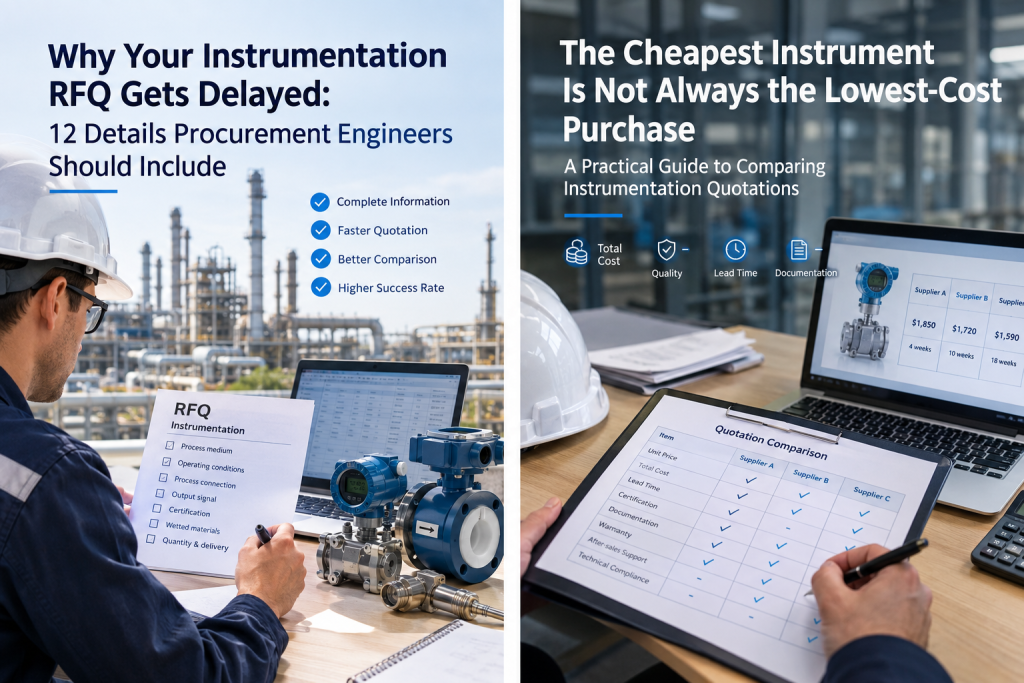
When an instrumentation procurement project reaches the quotation stage, the comparison often becomes very simple.
Supplier A: USD 1,850
Supplier B: USD 1,720
Supplier C: USD 1,590
The spreadsheet is updated.
Supplier C appears to have the lowest price.
But is Supplier C actually offering the lowest-cost solution?
For process instrumentation, the answer cannot be determined from the first number on the quotation.
A pressure transmitter, electromagnetic flow meter, radar level transmitter or water-quality analyzer is not simply a box with a price tag. The final purchasing cost can also include configuration, certification, documentation, accessories, freight, commissioning requirements, replacement risk, lead time and compatibility with the existing control system.
This is particularly important for international procurement.
A supplier may offer a lower unit price while another supplier provides a more complete configuration, faster availability or documentation that avoids additional engineering work.
For procurement engineers, the useful concept is therefore not simply unit price.
It is total procurement cost.
1. Start With an Apples-to-Apples Comparison
Before comparing prices, compare the technical configurations.
Suppose two suppliers quote an electromagnetic flow meter.
Supplier A:
- DN100
- 4–20 mA
- HART
- PTFE lining
- Hastelloy electrodes
- Remote transmitter
- PN16 flange
- Calibration certificate
Supplier B:
- DN100
- 4–20 mA
- Basic configuration
- Different electrode material
- Local display
- Standard documentation
Supplier B is cheaper.
But the two quotations are not necessarily equivalent.
The first question should therefore be:
Are we comparing the same instrument configuration?
FUGUI’s flow measurement range illustrates why flow-meter selection needs more than nominal pipe size. Medium, operating range, pressure, temperature, conductivity and connection requirements all influence the selection.
A procurement spreadsheet should therefore have a technical verification column before the price column.
2. Model Number Alone Does Not Always Tell the Whole Story
Industrial instruments frequently use structured ordering codes.
One small change in the code can represent:
- Different process connection
- Different housing
- Different sensor material
- Different communication protocol
- Different display
- Different certification
- Different pressure rating
- Different power supply
- Different mounting arrangement
This is why two quotations that look like they refer to “the same model” should still be checked carefully.
If the customer provides a complete ordering code, the supplier should quote against that exact configuration.
If the customer provides only a family name, the supplier should confirm the missing configuration before final pricing.
This is especially important for international buyers purchasing brands such as Endress+Hauser, Yokogawa, Rosemount, Siemens and other major process instrumentation manufacturers.
The familiar brand name is not enough.
The complete ordering configuration matters.
3. Documentation Has a Procurement Cost
Documentation is often treated as free.
It is not always free in practical terms.
An EPC project may require:
- Datasheet
- General arrangement drawing
- Wiring diagram
- Calibration certificate
- Material certificate
- Certificate of conformity
- Hazardous-area certificate
- Inspection documents
- Test report
- Operation manual
- Country-of-origin documentation
If the supplier cannot provide the required documents, the procurement team may spend additional time obtaining them.
In a project environment, engineering hours have a cost.
More importantly, missing documents can delay approval.
That can delay purchasing.
And delayed purchasing can affect installation and commissioning.
For this reason, a quotation comparison should include a simple field:
Documentation included: Yes / No / To be confirmed
That one column can prevent surprisingly complicated discussions later.
4. Certificates Can Change the Price
The same basic measurement technology can have different commercial requirements depending on where the instrument will be installed.
For example, a standard industrial transmitter may be sufficient for a non-hazardous utility area.
A transmitter installed in a classified area may require appropriate hazardous-area certification.
A water-treatment project may require drinking-water approval.
A food-processing application may require hygienic or food-contact compliance.
A marine project may require marine approvals.
The procurement team should therefore avoid writing:
“Certification required.”
Instead, specify the actual requirement.
For example:
IECEx required.
or:
ATEX required.
or:
Drinking-water approval required.
If the project specification is unclear, ask engineering to confirm before requesting final quotations.
5. The Cheapest Price Can Become Expensive When Lead Time Changes
Price and lead time should always be reviewed together.
Imagine three quotations:
| Supplier | Unit Price | Manufacturing Lead Time |
|---|---|---|
| A | $2,000 | 4 weeks |
| B | $1,850 | 10 weeks |
| C | $1,650 | 18 weeks |
Supplier C has the lowest unit price.
But suppose the plant needs the instrument in six weeks.
The commercial decision is no longer simply a $350 saving.
The procurement team must consider what happens if the instrument arrives after the required installation date.
For a maintenance replacement, this can be even more important.
If a failed transmitter is stopping a process line, the cost of waiting may be much greater than the difference between two quotations.
This does not mean the fastest supplier is automatically the right supplier.
It means price and timing should be evaluated together.
When requesting a quotation, clearly separate:
Manufacturing lead time
from
Estimated transportation time
and from
Required delivery date.
That removes one of the most common sources of misunderstanding in international instrumentation procurement.
6. Spare Parts Are Part of the Purchase Decision
A new instrument may be inexpensive.
Maintaining it over several years may be a different matter.
Before purchasing a large batch of instruments, procurement and maintenance teams should consider:
- Sensor replacement cost
- Electronics replacement cost
- Gasket availability
- Probe replacement
- Calibration requirements
- Local service capability
- Communication compatibility
- Expected spare inventory
For a plant with dozens or hundreds of instruments, these factors become more significant.
The purchase price is only the beginning of the instrument’s commercial life.
For plants operating Yokogawa-based control systems, for example, DCS hardware can become particularly important during maintenance and obsolescence situations. FUGUI’s Yokogawa DCS spare-parts range is one example of why procurement planning should include both new instrumentation and replacement hardware.
7. Compatibility Can Be More Valuable Than a Small Price Difference
Imagine replacing a pressure transmitter in an existing plant.
The new transmitter must communicate with the existing control system.
The process connection must match.
The output range must be correct.
The mounting arrangement must work.
The engineering database may already be based on a particular brand.
A theoretically cheaper instrument may create additional work if it requires changes elsewhere.
For this reason, replacement procurement should always distinguish between:
New application
and
Like-for-like replacement.
For a replacement, the old model, serial information, nameplate photo and existing datasheet can be extremely valuable.
If possible, send photographs of the nameplate together with the RFQ.
That allows the supplier to verify the exact configuration rather than guessing from a shortened model description.
8. Pressure Transmitters: Compare the Details, Not Just the Range
Suppose two suppliers quote:
Pressure transmitter, 0–10 bar, 4–20 mA.
That sounds identical.
But there may be differences in:
- Gauge vs absolute pressure
- Accuracy
- Process connection
- Electrical connection
- Wetted material
- Diaphragm material
- Seal material
- HART capability
- Housing material
- Display
- Ex certification
- Overpressure rating
- Temperature range
FUGUI’s pressure measurement product range includes pressure and differential-pressure measurement products, but the correct configuration still depends on the real process conditions.
For procurement teams, this means the quotation should be checked against the original datasheet—not just the product title.
9. Level Instruments Need Installation Verification
Level measurement creates another common comparison problem.
Two suppliers may both offer radar level transmitters with similar measuring ranges.
But the installation conditions may be different.
The tank could contain:
- Agitators
- Heating coils
- Internal pipes
- Ladders
- Foam
- Vapor
- Dust
- Turbulence
- Corrosive chemicals
A model suitable for a quiet storage tank may not be the right choice for a highly turbulent process vessel.
FUGUI’s level measurement range covers radar and ultrasonic measurement technologies for different applications.
The procurement engineer does not necessarily need to determine the final technology alone.
The important step is to give the supplier enough installation information to make a technically defensible recommendation.
10. Water-Quality Instruments Require an Even Broader Comparison
Water-quality projects can involve several measurement parameters:
- pH
- ORP
- Conductivity
- Dissolved oxygen
- Turbidity
- Residual chlorine
The controller is only one part of the system.
Sensors, holders, cables, cleaning systems and calibration requirements may also need to be considered.
FUGUI’s water-quality analysis range includes online process-water measurement solutions.
When comparing quotations, ask:
Does this price cover only the transmitter/controller, or the complete measurement point?
That question can prevent a very low quotation from becoming a much larger purchase after the missing components are discovered.
11. Freight Should Be Compared Carefully
International buyers sometimes compare one supplier’s product price with another supplier’s delivered price.
That produces misleading results.
For example:
Supplier A:
USD 1,500 + freight
Supplier B:
USD 1,680 delivered
Supplier A may look cheaper.
But once freight, insurance and other charges are added, the difference may be much smaller.
The quotation should therefore state the commercial basis clearly.
Depending on the project, this may include:
- EXW
- FOB
- CIF
- DAP
- Other agreed Incoterms
Do not assume that “price” means the same thing across suppliers.
12. Warranty Is Another Part of the Comparison
Warranty is easy to ignore because the buyer hopes never to use it.
But industrial instrumentation operates in environments where installation conditions, process compatibility and electronics can all affect reliability.
A quotation should make clear:
- Warranty period
- Warranty start date
- Scope of warranty
- Exclusions
- Replacement procedure
- Technical support availability
A supplier offering a slightly higher price with clear after-sales support may provide a different commercial proposition from a supplier offering only a product with minimal documentation.
Again, this is not about automatically choosing the more expensive option.
It is about making sure the comparison is complete.
13. Build a Technical-Commercial Comparison Sheet
For recurring instrumentation purchases, a standard comparison sheet can save a considerable amount of time.
A practical structure might look like this:
| Item | Supplier A | Supplier B | Supplier C |
|---|---|---|---|
| Brand | |||
| Complete model | |||
| Measurement principle | |||
| Measuring range | |||
| Process connection | |||
| Wetted materials | |||
| Output | |||
| Communication | |||
| Certification | |||
| Documentation | |||
| Warranty | |||
| Manufacturing lead time | |||
| Freight basis | |||
| Unit price | |||
| Total price | |||
| Technical deviations |
Notice that unit price is near the bottom.
That is deliberate.
Technical equivalence should be checked before price becomes the dominant factor.
14. Ask Suppliers to Declare Deviations
One simple procurement habit can make quotation comparison much easier:
“Please clearly identify any deviation from the requested specification.”
This sentence gives the supplier permission to be transparent.
If a supplier cannot provide the exact requested configuration but can offer an alternative, the quotation should say so.
For example:
Requested: HART
Offered: Modbus
or:
Requested: PN16
Offered: Class 150
or:
Requested: IECEx
Offered: ATEX only
A deviation is not necessarily unacceptable.
The important thing is that engineering and procurement know about it before the purchase order is issued.
15. When Should You Ask for an Alternative Brand?
There are several reasonable situations.
The specified brand may have a long manufacturing lead time.
The original model may be discontinued.
The project may allow approved equivalents.
The buyer may be conducting a budget comparison.
The plant may need an emergency replacement.
In these cases, ask suppliers to separate:
Specified brand quotation
and
Alternative quotation
Do not mix them into one price.
This makes internal approval much easier.
For example:
Option A — Endress+Hauser
Option B — Yokogawa
Option C — Chongqing Chuanyi
The engineering team can then review technical equivalence separately from procurement cost.
The Real Meaning of a “Low Price”
A low unit price is useful.
But it is only useful when you know what you are buying.
For industrial instrumentation, a quotation should answer five basic questions:
What exactly is being supplied?
Is it technically suitable?
When can it be delivered?
What documentation comes with it?
What will the complete purchase cost?
Only after those questions are answered should the unit price become the main comparison point.
This is particularly important when purchasing internationally, where supplier location, logistics, documentation, technical support and brand sourcing can all influence the final result.
FUGUI Automation supplies temperature measurement, pressure measurement, flow measurement, level measurement and water-quality instruments, allowing buyers to discuss multiple measurement points with one industrial instrumentation supplier.
The objective is not to make every quotation more complicated.
It is to make the final purchase easier to defend.
A good procurement decision should survive three questions from management:
Why was this supplier selected?
What exactly did we compare?
What risks were considered besides price?
If the answer is documented clearly, the purchasing decision becomes much easier to explain.
And that is ultimately what a good instrumentation quotation should provide:
not just a number, but a clear basis for making a purchase.
If you have several quotations for the same instrument and are not sure whether they are technically comparable, send the model numbers, datasheets or RFQ details to an instrumentation supplier for a configuration check before placing the order.