
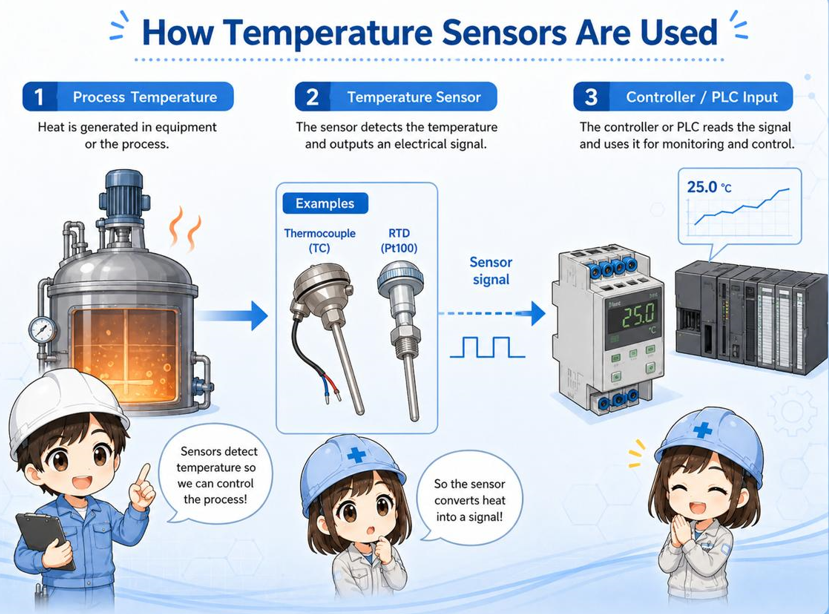
Introduction: Choosing the Right Temperature Sensor for Industrial Process Control
Temperature is one of the most important process variables in industrial automation.
In chemical plants, power stations, oil refineries, food processing facilities, pharmaceutical manufacturing and industrial production lines, accurate temperature measurement directly affects product quality, process stability, energy efficiency and equipment safety.
Two of the most widely used temperature sensing technologies are Resistance Temperature Detectors (RTDs) and thermocouples.
Both convert temperature changes into measurable electrical signals, but their operating principles, accuracy characteristics, temperature capabilities and installation requirements are different.
For instrumentation engineers and procurement specialists, choosing between an RTD and a thermocouple is not simply a matter of comparing purchase prices.
The correct decision depends on the actual operating temperature, required accuracy, response time, vibration, process medium, installation arrangement and signal transmission requirements.
This guide provides a practical engineering comparison of RTD and thermocouple sensors and explains how to select the right industrial temperature measurement solution.
1. What Is an RTD Temperature Sensor?
An RTD is a temperature sensor that measures temperature through changes in electrical resistance.
RTD stands for Resistance Temperature Detector.
The sensing element is usually made from platinum because platinum provides a relatively stable and predictable resistance-temperature relationship.
Common industrial RTD types include:
- Pt100
- Pt1000
- Pt500
The most commonly used industrial platinum RTD is Pt100.
A Pt100 sensor has a nominal resistance of 100 ohms at 0°C.
As temperature increases, the resistance of the platinum element increases in a predictable manner.
The measuring system detects this resistance change and converts it into a temperature value.
How Does an RTD Work?
The basic RTD measurement process involves four stages.
Stage 1: Temperature Exposure
The sensing element is installed in contact with the measured process through a suitable protective sheath or thermowell.
Stage 2: Resistance Change
As the temperature changes, the electrical resistance of the platinum element changes.
Stage 3: Resistance Measurement
The transmitter or measuring instrument supplies a controlled measuring current and measures the resulting voltage.
Stage 4: Temperature Conversion
The resistance value is converted into temperature according to the applicable RTD characteristic.
Industrial RTD measurement commonly follows IEC 60751 for platinum resistance thermometers.
Pt100 vs Pt1000
| Parameter | Pt100 | Pt1000 |
|---|---|---|
| Nominal Resistance at 0°C | 100 Ω | 1000 Ω |
| Sensing Material | Platinum | Platinum |
| Typical Application | Industrial process measurement | Industrial and specialized measurement |
| Wiring | 2 / 3 / 4 wire | 2 / 3 / 4 wire |
| Measurement Principle | Resistance change | Resistance change |
The correct sensor type should match the measuring transmitter or input module.
2. What Is a Thermocouple Temperature Sensor?
A thermocouple measures temperature through the thermoelectric effect.
It consists of two conductors made from different materials joined together at a measuring junction.
When the measuring junction and reference junction are at different temperatures, a small thermoelectric voltage is generated.
This voltage is related to the temperature difference and the specific thermocouple type.
Common industrial thermocouple types include:
- Type K: Chromel–Alumel
- Type J: Iron–Constantan
- Type T: Copper–Constantan
- Type N: Nicrosil–Nisil
- Type R and S: Platinum-rhodium based
- Type B: Platinum-rhodium based
Different thermocouple types have different temperature ranges, sensitivities, stability characteristics and environmental limitations.
Type K is widely used in general industrial temperature measurement.
Thermocouples are particularly useful in applications involving high temperatures, furnaces, kilns, boilers and thermal processing equipment.
How Does a Thermocouple Work?
Stage 1: Temperature Difference
The measuring junction is exposed to the process temperature.
Stage 2: Thermoelectric Voltage
A voltage develops because the two dissimilar conductor materials experience a temperature difference between the measuring and reference junctions.
Stage 3: Signal Measurement
The temperature measuring instrument detects the small millivolt-level signal.
Stage 4: Cold Junction Compensation
The measuring system compensates for the reference junction temperature.
Stage 5: Temperature Calculation
The voltage is converted into temperature according to the thermocouple type and applicable reference tables.
Correct extension wire and polarity are essential for reliable measurement.
3. RTD vs Thermocouple: Main Technical Differences
The following table summarizes the major differences.
| Comparison | RTD | Thermocouple |
|---|---|---|
| Measuring Principle | Resistance change | Thermoelectric voltage |
| Common Type | Pt100 / Pt1000 | K / J / T / N / R / S |
| Accuracy | Generally higher in suitable operating ranges | Depends on type and grade |
| Temperature Capability | Depends on element and construction | Can support very high temperatures with suitable types |
| Response Time | Depends on probe construction | Depends on junction and probe construction |
| Wiring | 2 / 3 / 4 wire | Two thermocouple conductors |
| Stability | Generally excellent in suitable applications | Depends on type, temperature and environment |
| Signal Level | Resistance measurement | Millivolt signal |
| Typical Application | Precise process measurement | High-temperature process measurement |
There is no universal winner.
A Pt100 RTD may be preferable for precise moderate-temperature process monitoring, while a suitable thermocouple may be the better option for a high-temperature furnace.
4. RTD Accuracy vs Thermocouple Accuracy
Accuracy is often the first factor considered during instrument selection.
RTDs generally offer excellent accuracy and repeatability over their specified operating ranges.
For example, IEC 60751 defines accuracy classes for platinum resistance thermometers.
Thermocouple accuracy depends on the thermocouple type, material grade, temperature range, manufacturing tolerances and reference standard.
However, the complete measurement system must be considered.
The final measurement uncertainty can also be affected by:
- Transmitter accuracy
- Input module accuracy
- Wiring resistance
- Electrical noise
- Sensor installation
- Thermal gradients
- Calibration condition
- Long-term sensor drift
A high-accuracy sensor connected to an unsuitable measuring system will not necessarily deliver a high-accuracy process measurement.
For critical applications, evaluate the entire measurement chain rather than relying only on the sensor’s published accuracy class.
5. Temperature Range: When Should You Use an RTD or Thermocouple?
The temperature range is a major selection criterion.
RTD Applications
Platinum RTDs are commonly used for:
- Water temperature
- Oil temperature
- Chemical process temperature
- Heat exchanger monitoring
- HVAC systems
- Industrial pipelines
- Food and beverage processing
- General process control
The actual maximum temperature depends on the RTD element, sheath, insulation, protective construction and measuring assembly.
Thermocouple Applications
Thermocouples are commonly selected for:
- Industrial furnaces
- Kilns
- Boilers
- Heat treatment equipment
- Combustion systems
- High-temperature exhaust gas
- Metal processing
- Industrial heating systems
High-temperature applications may require specialized thermocouple types and protective materials.
Always check the manufacturer’s maximum continuous operating temperature rather than using a generic sensor-type temperature limit.
6. Understanding 2-Wire, 3-Wire and 4-Wire RTD Connections
Wiring configuration affects RTD measurement accuracy.
2-Wire RTD
A two-wire RTD is simple to install but lead resistance can introduce measurement error.
It is generally suitable for applications where lead resistance is small relative to the required accuracy.
3-Wire RTD
Three-wire RTD measurement is widely used in industrial automation.
The measuring system compensates for lead resistance under the assumption that the relevant lead resistances are sufficiently similar.
This provides a practical balance between measurement accuracy and installation cost.
4-Wire RTD
Four-wire measurement can largely eliminate lead resistance effects when implemented correctly.
It is often used in laboratory and high-accuracy measurement applications.
For industrial replacement projects, confirm the wiring configuration supported by the transmitter or DCS input module before ordering.
7. What Is an Industrial Temperature Transmitter?
A temperature sensor measures the physical temperature, but the resulting signal often needs to be converted into a form suitable for industrial control systems.
A temperature transmitter performs this signal conversion.
Common functions include:
- RTD resistance measurement
- Thermocouple millivolt measurement
- Linearization
- Cold junction compensation
- Sensor diagnostics
- Signal conversion
- 4–20 mA output
Temperature transmitters may be installed in sensor connection heads or mounted on DIN rails inside control cabinets.
A common industrial output is 4–20 mA.
Some transmitters also support HART communication for configuration and diagnostics.
When selecting a replacement temperature transmitter, confirm sensor input type, wiring arrangement, output signal, power supply, mounting arrangement and communication requirements.
8. Important Factors When Selecting an Industrial Temperature Sensor
Process Temperature
Identify minimum, normal, maximum and design temperatures.
Sensor Element
Select Pt100, Pt1000 or the appropriate thermocouple type.
Accuracy Requirement
Determine the required measurement uncertainty and applicable tolerance class.
Response Time
Consider probe diameter, sheath material, insertion length, thermal contact and process velocity.
Sheath Material
Common materials include stainless steel 304, 316L and other alloys selected according to process compatibility.
Insertion Length
The sensor should be installed at a suitable depth to obtain representative process temperature.
Vibration
High-vibration applications may require mineral-insulated or mechanically reinforced probe construction.
Hazardous Areas
Confirm the exact explosion-protection approval for the complete sensor assembly and installation.
Transmitter Compatibility
Check the measuring input type and required signal output.
9. RTD and Thermocouple Applications Across Different Industries
Oil and Gas: Pipeline temperature, compressor systems, storage equipment, refinery process lines and furnace monitoring.
Chemical Processing: Reactor temperature, heat exchangers, storage vessels and chemical circulation systems.
Power Generation: Boiler systems, turbine auxiliary equipment, steam lines and cooling systems.
Food and Beverage: Product temperature, process heating, pasteurization and hygienic manufacturing.
Pharmaceutical Manufacturing: Temperature monitoring in controlled production and utility systems.
Steel and Metallurgy: Furnaces, heat treatment, casting and high-temperature processing.
HVAC and Utilities: Chilled water, heating circuits, air handling equipment and thermal management.
Industrial Manufacturing: Machinery, production lines, hydraulic equipment and process utilities.
10. RTD vs Thermocouple: How to Make the Final Decision
Use an RTD when:
- Measurement accuracy and stability are important.
- The process temperature is within the selected RTD’s capability.
- A platinum sensing element is suitable.
- The installation supports the required wiring configuration.
- Long-term repeatability is a priority.
Use a thermocouple when:
- The application involves high temperatures.
- Furnace or combustion measurement is required.
- A suitable thermocouple type meets the process conditions.
- Mechanical construction and response time match the installation.
- The measuring system supports the required thermocouple input.
For some plants, both technologies are required in different sections of the same process.
The selection should be based on process engineering requirements, not simply brand preference.
11. Temperature Measurement Products from FUGUI Automation
FUGUI Automation supplies industrial temperature sensors, transmitters and related process instruments.
Our product portfolio includes temperature measurement solutions for industrial process control, equipment monitoring and instrumentation replacement.
Explore the following product pages:
- Chongqing Chuanyi WZGPK Explosion-proof Pt100 RTD Temperature Sensor
- E+H Deltabar PMD55B Differential Pressure Transmitter
- Chongqing Chuanyi PDS843 Differential Pressure Transmitter
- E+H FMR30B Radar Level Transmitter
- E+H Levelflex FMP56 Guided Wave Radar
- E+H FMU30 Ultrasonic Level Transmitter
- E+H FMU40 Ultrasonic Level Transmitter
- E+H Prosonic Flow W 400 Ultrasonic Flowmeter
- E+H Promass X 300 Coriolis Mass Flowmeter
- Yokogawa S2CP471-01 Controller Module
12. Temperature Sensor RFQ Checklist
When requesting an RTD or thermocouple quotation, provide:
| Parameter | Required Information |
|---|---|
| Sensor Type | RTD / Thermocouple |
| Element | Pt100 / Pt1000 / K / J / T / Other |
| Measuring Range | Minimum / Maximum |
| Accuracy | Class and tolerance |
| Wiring | 2 / 3 / 4 wire |
| Sheath Material | 304 / 316L / Alloy |
| Probe Diameter | Required diameter |
| Insertion Length | Required length |
| Process Connection | Thread / Flange / Other |
| Junction Box | Required construction |
| Transmitter | Head / DIN rail / None |
| Output | 4–20 mA / Thermocouple / RTD |
| Certification | Required Ex approval |
| Quantity | Required units |
For replacement sensors, provide the existing nameplate, installation drawing or complete model code.
13. Frequently Asked Questions
Q1: What is the main difference between RTD and thermocouple sensors?
An RTD measures temperature through electrical resistance changes, while a thermocouple measures the thermoelectric voltage generated by two dissimilar conductors.
Q2: Is Pt100 more accurate than a thermocouple?
Pt100 sensors generally offer better accuracy and stability in many moderate-temperature applications, but the actual performance depends on sensor class, construction and measuring system.
Q3: What does Pt100 mean?
Pt100 means a platinum resistance temperature detector with a nominal resistance of 100 ohms at 0°C.
Q4: What is the most common industrial thermocouple?
Type K is widely used for general industrial temperature measurement, especially in heating and high-temperature applications.
Q5: Which sensor is better for high-temperature furnaces?
A suitable thermocouple is often preferred for high-temperature furnace measurement. The specific type and protective construction must match the temperature and atmosphere.
Q6: What is a 3-wire Pt100 sensor?
It is an RTD sensor with three electrical connections that allow compatible measuring instruments to compensate for lead resistance.
Q7: What is a 4–20 mA temperature transmitter?
It converts an RTD or thermocouple input into a standardized current output for PLC and DCS integration.
Q8: Can an RTD be used in hazardous areas?
Yes. Suitable RTD assemblies and transmitters are available with relevant hazardous-area approvals. Check the complete installation certification.
Q9: How do I choose between Pt100 and Pt1000?
Consider the measuring instrument’s input compatibility, lead resistance, wiring arrangement and required accuracy.
Q10: How can I request a temperature sensor quotation?
Send the sensor type, measuring range, accuracy, probe dimensions, process connection, output requirements and destination country to FUGUI Automation.
14. Request an Industrial Temperature Sensor Quotation
Need an industrial Pt100 RTD, armored thermocouple, explosion-proof temperature sensor or temperature transmitter?
FUGUI Automation supports international customers with process instrumentation sourcing and technical model verification.
WhatsApp: +86 188 2705 8766
Send your technical specifications or existing model number to request a quotation.
FUGUI Automation — Industrial Temperature Measurement and Automation Instrumentation for Global Buyers.