
Introduction: Why Electromagnetic Flow Measurement Is Important
Accurate liquid flow measurement is essential for process control, production management, energy optimization and commercial operations.
In water treatment plants, chemical factories, mining operations, food production facilities and industrial utility systems, flowmeters provide information about how much liquid moves through a pipeline over a specific period.
Among the available technologies, the electromagnetic flowmeter is widely used for measuring conductive liquids.
It offers several advantages: no moving mechanical measuring parts in the flow tube, no obstruction from a conventional turbine rotor and suitability for many conductive liquids and slurries.
However, electromagnetic flow measurement is not suitable for every fluid. Understanding its operating principle and application limits is essential before purchasing.
1. What Is an Electromagnetic Flowmeter?
An electromagnetic flowmeter, often called a mag meter or magnetic flow meter, measures the volumetric flow rate of an electrically conductive liquid.
It operates according to Faraday’s law of electromagnetic induction.
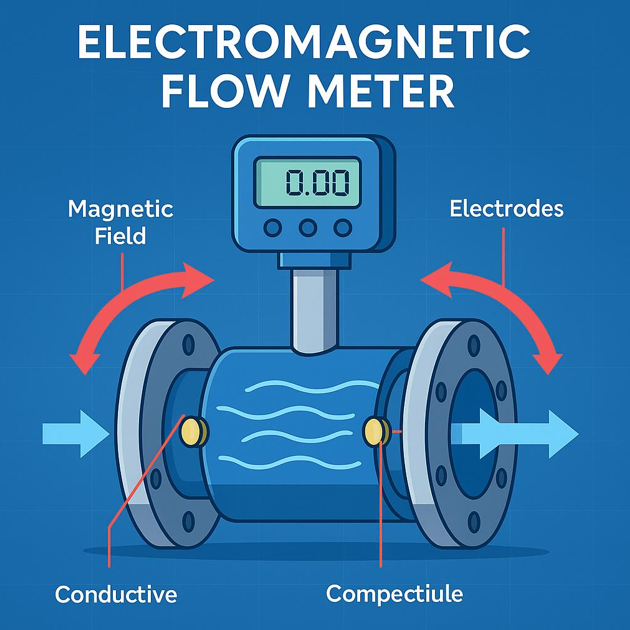
The basic measuring system consists of:
- Flow tube
- Magnetic coils
- Measuring electrodes
- Electrical insulation liner
- Signal converter or transmitter
- Power supply and output interface
When a conductive liquid passes through the magnetic field, an electrical voltage is induced.
The measuring electrodes detect this voltage, and the transmitter processes it to calculate flow velocity and volumetric flow rate.
Unlike many mechanical flowmeters, an electromagnetic flowmeter does not require a rotating impeller or turbine inside the measuring tube.
2. Electromagnetic Flowmeter Working Principle
Faraday’s Law of Electromagnetic Induction
Faraday’s law states that a voltage is induced when a conductor moves through a magnetic field.
In a magnetic flowmeter, the conductive liquid acts as the moving conductor.
The induced voltage is proportional to the average fluid velocity and magnetic field strength.
For a simplified electromagnetic flow measurement relationship:
E = B × L × v
Where:
- E = Induced voltage
- B = Magnetic flux density
- L = Distance between measuring electrodes
- v = Average fluid velocity
The transmitter uses the measured voltage and calibrated geometry to calculate flow velocity.
The volumetric flow rate is then calculated from:
Q = v × A
Where:
- Q = Volumetric flow rate
- v = Average flow velocity
- A = Internal cross-sectional area of the measuring pipe
This is the fundamental principle behind electromagnetic flow measurement.
Step 1: Generate a Magnetic Field
Electrical excitation is supplied to coils surrounding the measuring tube.
The coils generate a magnetic field across the flow section.
The excitation method varies by instrument design. Modern meters may use pulsed DC, dual-frequency or other excitation technologies.
Step 2: Conductive Liquid Passes Through the Meter
The process liquid flows through the lined measuring tube.
As the conductive liquid moves across the magnetic field, an induced electrical potential is generated.
Step 3: Electrodes Detect the Induced Voltage
Electrodes positioned on opposite sides of the measuring tube detect the induced voltage.
The electrode signal is relatively small, so the transmitter must process it carefully to distinguish the actual flow signal from electrical interference and process noise.
Step 4: Signal Processing
The converter amplifies and processes the measured signal.
Depending on the model, additional features may include:
- Empty pipe detection
- Electrode monitoring
- Noise suppression
- Flow direction detection
- Low-flow cutoff
- Diagnostic information
- Totalization
Step 5: Flow Output to PLC or DCS
The flow transmitter converts the calculated measurement into an output such as:
- 4–20 mA
- Pulse or frequency
- HART
- PROFIBUS
- Modbus
- Other supported industrial protocols
The control system uses the measurement for monitoring, batching, process control and reporting.
3. Which Liquids Can an Electromagnetic Flowmeter Measure?
The most important requirement is electrical conductivity.
Typical suitable applications include:
- Drinking water
- Wastewater
- Industrial process water
- Acid and alkali solutions
- Chemical liquids
- Slurry
- Pulp and paper stock
- Mining process fluids
- Many food and beverage liquids
The minimum conductivity requirement depends on the particular meter design and manufacturer specifications.
An electromagnetic flowmeter is generally unsuitable for ordinary non-conductive liquids such as many hydrocarbons, oils and pure deionized liquids.
For these applications, engineers may consider Coriolis, ultrasonic or other suitable flow measurement technologies.
4. Main Advantages of Electromagnetic Flowmeters
No Moving Measuring Parts
The absence of a rotating measuring mechanism reduces wear associated with mechanical moving parts.
No Conventional Obstruction
The measuring tube is generally unobstructed, making the technology useful for some slurry and solids-bearing liquid applications.
Bidirectional Measurement
Many electromagnetic flowmeters can measure flow in both directions when configured appropriately.
Low Pressure Loss
Because there is no conventional turbine rotor inside the measuring section, the meter can offer low permanent pressure loss.
Broad Industrial Applications
Different liner, electrode and housing configurations allow electromagnetic flowmeters to serve many water and chemical process applications.
Multiple Output Options
Modern converters can provide analog, pulse and digital communication outputs for integration into automation systems.
5. Electromagnetic Flowmeter Installation Requirements
Incorrect installation is a major cause of unstable flow measurements.
Full Pipe Condition
The measuring tube should remain completely full during normal measurement.
A partially filled pipe can produce inaccurate readings or measurement failure.
Straight Pipe Requirements
The required upstream and downstream straight lengths depend on the flowmeter design and the disturbances created by nearby valves, elbows, pumps and reducers.
Follow the manufacturer’s installation instructions rather than assuming one universal straight-run requirement.
Electrode Orientation
Electrode orientation should be selected to reduce the risk of air pockets, sediment accumulation and measurement interference.
Grounding and Electrical Bonding
Correct grounding is essential for reliable measurement.
The appropriate grounding rings, grounding electrodes or bonding arrangements depend on the pipeline material and meter design.
Avoid Excessive Vibration
The meter should be installed where mechanical vibration does not exceed the manufacturer’s permitted limits.
Consider Empty Pipe Conditions
Applications involving intermittent flow, drain-down or partially filled pipes require careful evaluation.
6. Selecting Liner and Electrode Materials
Material compatibility is particularly important for chemical and wastewater applications.
Liner Materials
Common options include:
- PTFE
- PFA
- Polyurethane
- Hard rubber
- Soft rubber
Selection depends on temperature, chemical compatibility, abrasion and pressure conditions.
Electrode Materials
Common electrode materials may include:
- Stainless steel
- Hastelloy
- Tantalum
- Titanium
- Platinum alloys
The correct choice must be based on the process medium and its concentration, temperature and operating conditions.
A material suitable for one acid concentration may not be suitable for another.
7. How to Select an Industrial Electromagnetic Flowmeter
Before requesting a quotation, engineers should prepare the following information.
Pipe size: DN15, DN50, DN100, DN200 or another nominal diameter.
Fluid: Water, wastewater, acid, alkali, slurry or process liquid.
Conductivity: Minimum expected electrical conductivity.
Flow range: Minimum, normal and maximum flow rates.
Operating pressure: Normal and maximum pressure.
Process temperature: Normal and maximum temperature.
Liner material: Selected according to chemical and thermal compatibility.
Electrode material: Selected according to corrosion and abrasion conditions.
Connection: Flanged, sanitary, wafer or other specified connection.
Output: 4–20 mA, pulse, HART, Modbus or fieldbus.
Protection: Required IP rating and hazardous-area approvals.
Installation: Local or remote converter, vertical or horizontal pipe, indoor or outdoor location.
8. Electromagnetic vs Ultrasonic vs Coriolis Flowmeters
| Technology | Suitable Measurement | Key Consideration |
|---|---|---|
| Electromagnetic | Conductive liquids | Requires sufficient conductivity |
| Ultrasonic Transit-Time | Many clean liquids | Fluid and pipe conditions affect performance |
| Coriolis | Mass flow and density | Higher initial cost and installation considerations |
| Vortex | Steam, gas and liquids | Requires suitable flow profile and operating conditions |
Choosing a flowmeter based solely on price can lead to long-term maintenance problems.
The correct technology depends on fluid properties, process conditions, required accuracy and lifecycle cost.
9. Industrial Applications
Water and Wastewater Treatment: Raw water, treated water, sludge and chemical dosing.
Chemical Processing: Acid transfer, alkali circulation, process liquids and chemical batching.
Mining: Slurry, mineral processing water and tailings systems.
Food and Beverage: Conductive liquids in hygienic installations with suitable meter design.
Pulp and Paper: Conductive process stock and wastewater.
Power Generation: Cooling water, auxiliary water and process liquid monitoring.
Agriculture: Irrigation distribution and water supply networks.
10. Recommended Flow and Process Instruments from FUGUI Automation
FUGUI Automation provides industrial flow measurement solutions from Yokogawa, Endress+Hauser and Chongqing Chuanyi.
Explore these product pages:
- Yokogawa ADMAG TI AXG150 Electromagnetic Flowmeter
- Chongqing Chuanyi MFL Two-Wire Electromagnetic Flowmeter
- Chongqing Chuanyi MFE-S Electromagnetic Flowmeter
- Chongqing Chuanyi MFD Slurry Electromagnetic Flowmeter
- Chongqing Chuanyi MFB Battery-Powered Electromagnetic Flowmeter
- Chongqing Chuanyi MFS Sanitary Electromagnetic Flowmeter
- E+H Prosonic Flow W 400 Clamp-on Ultrasonic Flowmeter
- E+H Promass X 300 Coriolis Mass Flowmeter
- E+H Deltabar PMD55B Differential Pressure Transmitter
- Chongqing Chuanyi PDS843 Differential Pressure Transmitter
Note: The MFL, MFE-S, MFD, MFB, MFS and AXG150 entries currently appear within FUGUI’s flow product family listing. Their links above point to that live family page, not separate model-specific product URLs.
11. Flowmeter RFQ Checklist for Industrial Buyers
| Parameter | Required Information |
|---|---|
| Medium | Exact fluid name and composition |
| Conductivity | Minimum conductivity |
| Pipe Diameter | DN / NPS |
| Flow Range | Minimum / normal / maximum |
| Pressure | Operating and design pressure |
| Temperature | Operating and maximum temperature |
| Liner | PTFE / PFA / Rubber / Other |
| Electrode | 316L / Hastelloy / Titanium / Other |
| Connection | Flange standard and rating |
| Output | 4–20 mA / Pulse / HART / Fieldbus |
| Installation | Local or remote converter |
| Quantity | Required units |
Providing these details helps suppliers identify a technically suitable electromagnetic flowmeter and avoid unnecessary quotation delays.
12. Frequently Asked Questions
Q1: What is the working principle of an electromagnetic flowmeter?
It uses Faraday’s law of electromagnetic induction. A conductive liquid moving through a magnetic field generates a voltage proportional to its velocity.
Q2: Can a magnetic flowmeter measure clean water?
Yes, provided the water meets the instrument’s minimum conductivity requirement.
Q3: Can an electromagnetic flowmeter measure oil?
Ordinary non-conductive oils are generally unsuitable. Other flowmeter technologies should be considered.
Q4: Can an electromagnetic flowmeter measure slurry?
Many models are designed for conductive slurry applications, but liner, electrode and abrasion resistance must be evaluated.
Q5: Does a mag meter have moving parts?
A conventional electromagnetic flowmeter has no rotating mechanical measuring element in the flow tube.
Q6: Can an electromagnetic flowmeter measure reverse flow?
Many models support bidirectional measurement when configured for that function.
Q7: Why must the pipe remain full?
The measuring principle assumes the designed measuring section is filled with conductive liquid. Partial filling can affect electrode contact and measurement accuracy.
Q8: What is the difference between an electromagnetic and ultrasonic flowmeter?
Electromagnetic meters require conductive liquids. Ultrasonic technologies can measure many liquids without requiring electrical conductivity.
Q9: How do I select the correct liner?
Evaluate chemical compatibility, temperature, pressure and abrasion conditions using the manufacturer’s material selection information.
Q10: How can I request an electromagnetic flowmeter quotation?
Send the pipe size, fluid composition, conductivity, flow range, pressure, temperature and connection standard to FUGUI Automation.
13. Request an Industrial Flowmeter Quotation
Looking for an electromagnetic flowmeter for water treatment, chemical processing, mining slurry or industrial liquid measurement?
FUGUI Automation can help review your process requirements and identify suitable flow measurement products.
WhatsApp: +86 188 2705 8766
Send your technical datasheet, existing model number or process specifications for quotation support.
FUGUI Automation — Reliable Industrial Flow Measurement and Process Instrumentation Sourcing.