
Introduction: Why Pressure Measurement Matters in Industrial Automation
Pressure measurement is one of the most important functions in modern industrial process control. From oil and gas pipelines to chemical reactors, power generation systems, water treatment facilities and manufacturing plants, accurate pressure data helps operators maintain stable operating conditions and protect equipment.
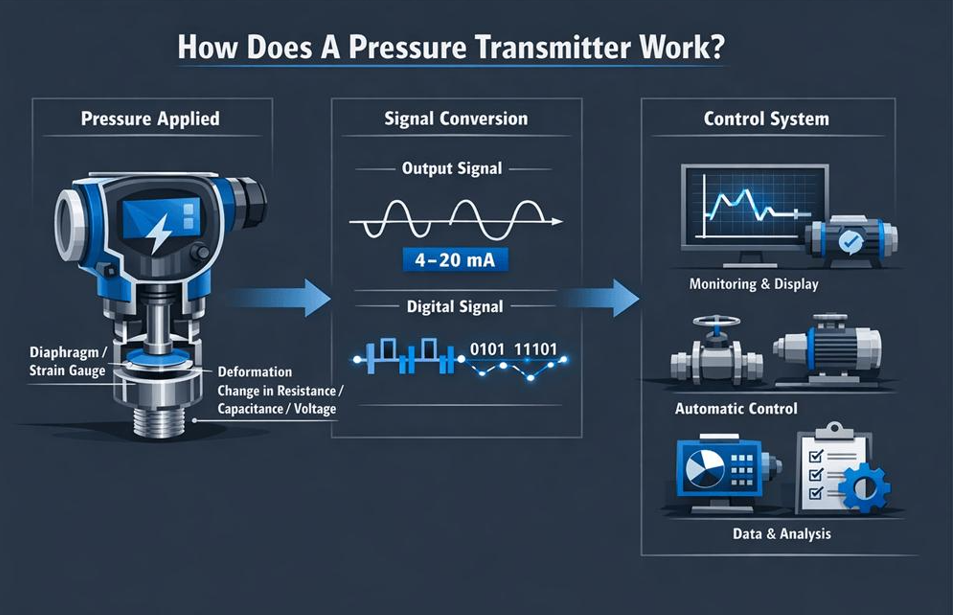
An industrial pressure transmitter does much more than display a pressure value. It converts a physical process variable into an electrical signal that can be transmitted to a PLC, DCS or other industrial control system.
For instrumentation engineers and procurement professionals, understanding the pressure transmitter working principle is essential when selecting replacement instruments, designing new process installations or upgrading existing automation systems.
Common purchasing searches include:
- Industrial pressure transmitter for sale
- Smart pressure transmitter 4–20 mA HART
- Differential pressure transmitter supplier
- High accuracy pressure transmitter for chemical plants
- Pressure transmitter for steam applications
- Pressure transmitter with stainless steel diaphragm
- Industrial pressure sensor replacement
- Pressure transmitter with explosion-proof certification
This guide explains the working principle, internal components, output signals, installation considerations and purchasing requirements of industrial pressure transmitters.
1. What Is an Industrial Pressure Transmitter?
An industrial pressure transmitter is an electronic instrument that measures pressure and converts the measured pressure into a standardized output signal.
Depending on the design, it can measure:
- Gauge pressure: Pressure relative to atmospheric pressure.
- Absolute pressure: Pressure relative to a vacuum reference.
- Differential pressure: The difference between two pressure inputs.
Pressure transmitters are commonly installed on pipelines, vessels, pumps, compressors, boilers, filters and industrial process equipment.
A typical smart pressure transmitter consists of:
- Process connection
- Isolation diaphragm
- Pressure sensing element
- Signal conditioning electronics
- Microprocessor
- Electrical enclosure
- Output and communication terminals
- Optional local display
The sensing technology may use piezoresistive, capacitive or other measurement principles depending on the instrument design.
2. Pressure Transmitter Working Principle: Step by Step
Step 1: Process Pressure Enters the Instrument
The process medium reaches the transmitter through a threaded, flanged or manifold connection.
An isolation diaphragm separates the process medium from the internal sensing system.
This arrangement is important when measuring corrosive, contaminated, high-temperature or otherwise challenging process media.
The selection of diaphragm materials must match the chemical properties and operating conditions of the application.
Step 2: The Sensor Detects Pressure
Pressure causes a mechanical change in the sensing element.
In a piezoresistive sensor, mechanical stress changes the electrical resistance of the sensing structure.
In a capacitive sensor, pressure-induced movement changes the capacitance between sensing elements.
The transmitter electronics interpret this change and convert it into a corresponding electrical measurement.
Step 3: Signal Conditioning and Compensation
The raw sensor signal may be affected by temperature, mechanical stress, electronic characteristics and long-term drift.
Modern smart pressure transmitters use electronic signal processing to compensate for relevant effects and improve measurement stability.
Depending on the instrument, additional features may include:
- Temperature compensation
- Sensor diagnostics
- Zero and span adjustment
- Digital configuration
- Measurement status monitoring
- Device identification
- Maintenance diagnostics
These functions are particularly useful in demanding process environments.
Step 4: Conversion into a Standard Output
Many industrial pressure transmitters provide a 4–20 mA analog output.
For a correctly configured linear transmitter, 4 mA represents the lower range value and 20 mA represents the upper range value.
For example, a transmitter configured for 0–10 bar produces approximately:
| Process Pressure | Output |
|---|---|
| 0 bar | 4 mA |
| 2.5 bar | 8 mA |
| 5 bar | 12 mA |
| 7.5 bar | 16 mA |
| 10 bar | 20 mA |
This relationship allows the control system to calculate process pressure from the measured current.
Some smart transmitters also support HART communication, which enables digital communication over a compatible 4–20 mA loop.
Step 5: PLC or DCS Receives the Measurement
The output signal is transmitted to an analog input channel in the control system.
The PLC or DCS scales the input signal into engineering units such as bar, kPa, MPa or psi.
Operators can then use the measurement for:
- Process monitoring
- High-pressure alarms
- Low-pressure alarms
- Pump control
- Compressor protection
- Interlock functions
- Process optimization
This is how a physical pressure measurement becomes usable information within an industrial automation system.
3. Gauge Pressure vs Absolute Pressure vs Differential Pressure
Choosing the correct measurement type is one of the most important steps in pressure transmitter procurement.
Gauge Pressure Transmitter
Gauge pressure measures pressure relative to the surrounding atmospheric pressure.
Typical applications include:
- Water supply pipelines
- Pump discharge monitoring
- Compressed air systems
- Hydraulic equipment
- General industrial process lines
Absolute Pressure Transmitter
Absolute pressure is measured relative to a perfect vacuum.
Typical applications include:
- Vacuum systems
- Distillation processes
- Condensers
- Laboratory process equipment
- Gas processing
Differential Pressure Transmitter
A differential pressure transmitter compares two pressure inputs.
Its measurement is:
Differential Pressure = High-Side Pressure − Low-Side Pressure.
Applications include:
- Filter blockage monitoring
- Flow measurement using primary elements
- Tank level measurement
- Heat exchanger monitoring
- Pressure drop measurement across equipment
For applications requiring differential pressure, engineers should carefully evaluate static pressure, overpressure limits and high-side/low-side connections.
4. Understanding 4–20 mA and HART Communication
The 4–20 mA current loop remains widely used in industrial instrumentation because of its robustness and suitability for long-distance signal transmission.
The 4 mA live zero helps distinguish a valid zero-range measurement from certain fault conditions.
HART communication adds digital information to a compatible analog current loop.
This can support:
- Remote configuration
- Device identification
- Diagnostic information
- Range adjustment
- Device status review
However, the actual communication capability depends on the transmitter, control system, loop design and installed interface equipment.
Before purchasing a smart pressure transmitter, confirm whether your existing DCS or PLC supports the required HART functions.
5. Important Factors When Selecting a Pressure Transmitter
A technically correct instrument selection requires more than choosing a measuring range.
Measuring Range and Operating Pressure
Confirm minimum, normal, maximum and design pressure.
The normal operating point should be considered when selecting the calibrated span.
Avoid selecting an unnecessarily wide range if measurement resolution is important.
Process Medium and Wetted Materials
Check whether the medium is corrosive, abrasive, viscous or prone to crystallization.
Common material considerations include 316L stainless steel, Hastelloy, Monel and tantalum.
The actual material must be verified against the process chemistry and manufacturer’s compatibility data.
Process Temperature
High process temperatures may require remote diaphragm seals, capillaries or special configurations.
Process Connection
Confirm thread type, flange standard, pressure rating and installation dimensions.
Electrical Output
Check 4–20 mA, HART, PROFIBUS PA, FOUNDATION Fieldbus or other required communication options.
Hazardous-Area Certification
For installations in explosive atmospheres, verify the exact equipment approval, protection concept, gas group, temperature class and applicable installation requirements.
Accuracy and Stability
Review reference accuracy, long-term drift, turndown ratio and the actual measurement uncertainty required by the process.
6. Pressure Transmitter Applications Across Major Industries
Oil and Gas: Pipeline pressure, compressor discharge, separator pressure and tank monitoring.
Chemical Processing: Reactor pressure, vessel monitoring, pump systems and differential pressure across filters.
Power Generation: Boiler auxiliary systems, steam equipment, cooling water and fuel systems.
Water and Wastewater: Pump stations, filtration systems, distribution pipelines and pressure zones.
Pharmaceutical Manufacturing: Process pressure and hygienic equipment monitoring, subject to suitable process connections and materials.
Food and Beverage: Tank pressure, hygienic process systems and CIP/SIP-compatible applications.
Industrial Manufacturing: Hydraulic systems, pneumatic equipment, compressors and production machinery.
7. Differential Pressure Transmitter for Flow and Level Measurement
A differential pressure transmitter can also be used for indirect flow and level measurement.
For flow measurement, a primary element such as an orifice plate creates a pressure difference related to flow rate.
For many conventional turbulent-flow applications, flow is approximately proportional to the square root of differential pressure, subject to the relevant fluid and installation conditions.
For closed pressurized tanks, differential pressure can be used to determine liquid level when the process configuration, density and pressure reference are properly considered.
This is why DP transmitters are widely used in process engineering.
8. Pressure Transmitter Calibration and Maintenance
Calibration verifies the relationship between applied pressure and instrument output.
A typical calibration procedure includes:
- Isolate the transmitter safely from the process.
- Connect a suitable pressure reference.
- Apply pressure at selected points.
- Record output values.
- Compare actual output with expected values.
- Adjust or document deviations according to the maintenance procedure.
- Reinstall and verify process operation.
The calibration interval should be based on process criticality, instrument performance history, manufacturer recommendations and applicable quality requirements.
Never loosen a process connection or remove an instrument before confirming the process is safely isolated and depressurized.
9. Recommended Pressure Transmitters and Related Instruments from FUGUI Automation
FUGUI Automation supplies industrial process measurement instruments from Endress+Hauser, Chongqing Chuanyi, Yokogawa, Rosemount, Siemens and other brands.
Explore the following product pages:
- Chongqing Chuanyi PDS843 Differential Pressure Transmitter
- E+H Deltabar PMD55B Differential Pressure Transmitter
- E+H Cerabar PMP51B Pressure Transmitter
- E+H FMR30B Radar Level Transmitter
- E+H Levelflex FMP56 Guided Wave Radar
- E+H FMU30 Ultrasonic Level Transmitter
- E+H FMU40 Ultrasonic Level Transmitter
- Chongqing Chuanyi MS22PSB2D10B0060DMZ Magnetostrictive Level Gauge
- E+H Prosonic Flow W 400 Ultrasonic Flowmeter
- E+H Promass X 300 Coriolis Mass Flowmeter
10. Pressure Transmitter Procurement Checklist for EPC and MRO Buyers
When preparing an RFQ, provide the following information:
| Requirement | Information to Provide |
|---|---|
| Measurement Type | Gauge / Absolute / Differential |
| Measuring Range | Minimum, normal and maximum |
| Process Medium | Liquid / Gas / Steam / Slurry |
| Process Temperature | Normal and maximum |
| Static Pressure | Applicable for DP transmitters |
| Wetted Materials | Diaphragm and process connection |
| Output | 4–20 mA / HART / Fieldbus |
| Accuracy | Required accuracy |
| Process Connection | Thread / Flange / Manifold |
| Certification | ATEX / IECEx / SIL, as required |
| Quantity | Required units |
| Existing Model | Manufacturer and complete model code |
For replacement projects, provide a photograph of the nameplate and the existing instrument’s complete model code. This helps reduce the risk of ordering an incompatible replacement.
11. Frequently Asked Questions
Q1: How does a pressure transmitter work?
It detects process pressure through a sensing element, converts the physical change into an electrical signal and processes the measurement into a standardized output.
Q2: What is the standard output of an industrial pressure transmitter?
A common output is 4–20 mA, often with optional HART communication.
Q3: What is the difference between a pressure sensor and a pressure transmitter?
A pressure sensor is the sensing element, while a transmitter generally incorporates signal conditioning and a standardized industrial output.
Q4: What is a differential pressure transmitter used for?
It measures pressure differences and is commonly used for flow, level, filter monitoring and equipment pressure-drop applications.
Q5: Can a pressure transmitter measure liquid, gas and steam?
Many models can, but the selection must consider medium compatibility, temperature, pressure and installation configuration.
Q6: How do I choose the right pressure transmitter range?
Use the normal and maximum operating conditions, required accuracy and design limits to establish a suitable calibrated span.
Q7: What is HART communication?
HART is a digital communication protocol that can operate over a compatible 4–20 mA current loop.
Q8: What information is needed for a replacement pressure transmitter?
Provide the existing model code, range, process connection, wetted materials, output, certification and operating conditions.
Q9: Can FUGUI Automation supply pressure transmitters for international projects?
FUGUI Automation supports international sourcing inquiries for industrial process instruments. Availability and delivery are confirmed against the requested model and configuration.
Q10: How can I request a pressure transmitter quotation?
Send the model number, datasheet or process specification to FUGUI Automation for technical review and quotation.
12. Request a Pressure Transmitter Quotation
Selecting the correct pressure transmitter is essential for measurement reliability, process safety and long-term operating performance.
Whether you need a differential pressure transmitter for flow measurement, a smart pressure transmitter for chemical processing or a replacement instrument for an existing DCS installation, FUGUI Automation can assist with product identification and sourcing.
Send your RFQ today.
WhatsApp: +86 188 2705 8766
Include your model number, quantity, operating conditions and destination country.
FUGUI Automation — Industrial Instrumentation & DCS Spare Parts for Global Buyers.