
Introduction: A One-Line RFQ Can Create a Two-Week Procurement Problem
One of the most common RFQs received by industrial instrumentation suppliers looks like this:
“Please quote one pressure transmitter.”
Another might say:
“Need electromagnetic flow meter, DN100.”
Or:
“Yokogawa DCS card required. Please send best price.”
For an ordinary product, this might be enough.
For industrial instrumentation, it often is not.
A professional supplier may need to send several emails asking for additional information.
What is the medium?
What is the pressure?
What is the temperature?
What is the actual flow range?
What is the process connection?
What is the output?
Which DCS or PLC is installed?
Which model is currently in service?
What certification is required?
What is the installation environment?
By the time all the information is collected, several days may have passed.
For an EPC contractor working against a project schedule, or an MRO buyer preparing for a shutdown, this delay is unnecessary.
A better RFQ is not necessarily a longer RFQ.
It is a more structured RFQ.
FUGUI’s process data checklist follows this principle: the supplier needs enough information to understand the application rather than simply the product category.
1. Why Industrial Instrumentation RFQs Are Different
A pressure transmitter is not defined only by its pressure range.
A flowmeter is not defined only by pipe diameter.
A level transmitter is not defined only by tank height.
A temperature sensor is not defined only by “Pt100.”
A DCS card is not defined only by “analog input.”
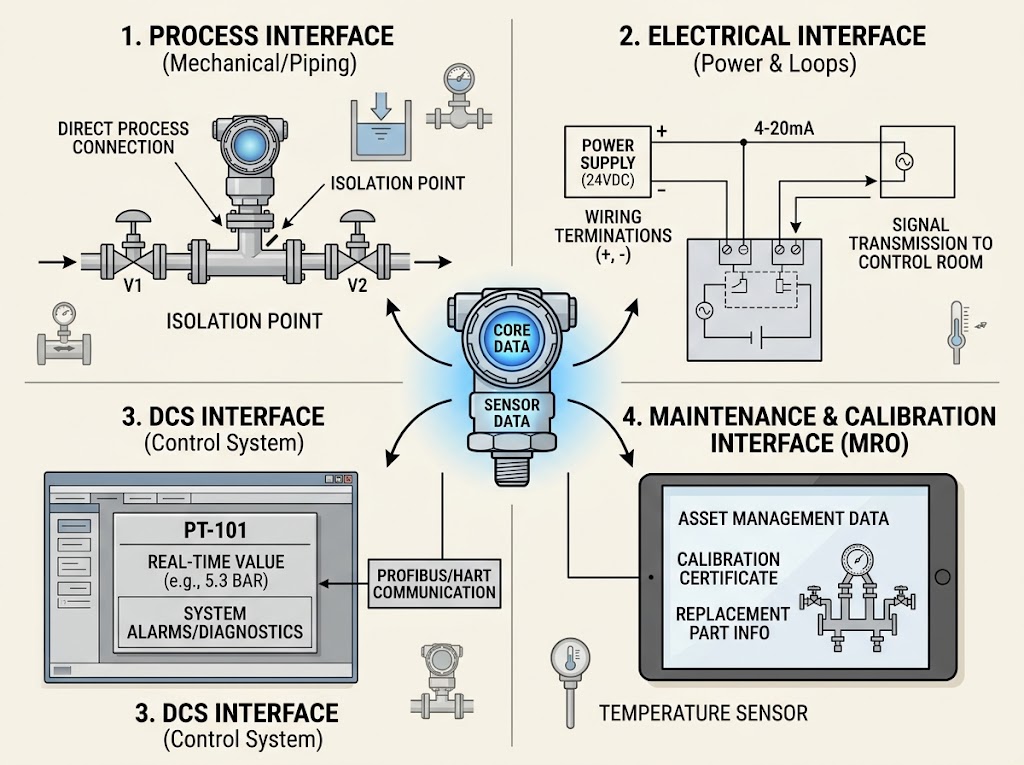
Every industrial instrument sits at the intersection of several systems.
Process
What is being measured?
Mechanical
How is the instrument installed?
Electrical
How is it powered and wired?
Control
How does it communicate with the automation system?
Compliance
What standards and certifications apply?
Commercial
When is it required and under what conditions?
A good RFQ makes these interfaces visible.
2. The 12 Data Points Every Buyer Should Prepare
For most instrumentation inquiries, twelve categories of information can dramatically improve quotation quality.
They are:
- Exact product or measurement function
- Application
- Medium
- Operating range
- Pressure
- Temperature
- Mechanical connection
- Electrical output
- Control system
- Certification
- Quantity
- Delivery and documentation requirements
Not every product needs every item.
But these twelve categories provide a strong starting point.
3. Data Point 1: Tell the Supplier What the Instrument Actually Does
Start with the measurement function.
Instead of:
“Need transmitter.”
write:
“Pressure transmitter for reactor pressure measurement.”
Instead of:
“Need flow meter.”
write:
“Electromagnetic flowmeter for cooling-water measurement.”
Instead of:
“Level sensor.”
write:
“Non-contact ultrasonic level transmitter for wastewater storage tank.”
This single sentence gives the supplier useful context.
It also reduces the chance of receiving a technically unsuitable quotation.
For buyers working with multiple suppliers, the FUGUI instrumentation portfolio can also be used to identify the relevant measurement category before submitting an RFQ.
4. Data Point 2: Explain the Application
The same instrument can behave very differently depending on the application.
For example:
Water
is not enough information.
Is it:
- drinking water?
- wastewater?
- cooling water?
- boiler feedwater?
- seawater?
- demineralized water?
- chemical process water?
Similarly:
Gas
could mean:
- natural gas;
- compressed air;
- oxygen;
- nitrogen;
- steam;
- process gas.
The application tells the supplier what technical questions need to be asked next.
5. Data Point 3: Identify the Process Medium
The measured medium affects instrument selection.
For pressure measurement, the supplier may need to understand:
- corrosiveness;
- density;
- viscosity;
- solids;
- chemical composition;
- phase.
For flow measurement, conductivity can be critical.
For level measurement, foam, vapour, dust and surface conditions may affect the technology.
For temperature measurement, the sensor material and thermowell arrangement may depend on the medium and operating conditions.
This is why “water flowmeter” is not necessarily a complete requirement.
6. Data Point 4: Give Minimum, Normal and Maximum Conditions
One of the most useful improvements a buyer can make is to stop providing only one operating number.
For flow, provide:
Minimum: 20 m³/h
Normal: 80 m³/h
Maximum: 120 m³/h
For pressure:
Minimum: 2 bar
Normal: 6 bar
Maximum: 10 bar
For temperature:
Minimum: 20°C
Normal: 60°C
Maximum: 90°C
This gives the supplier a real operating window.
A single value such as:
“Flow = 80 m³/h”
does not tell the complete story.
The E+H Prosonic Flow W 400, for example, is a non-invasive ultrasonic flow measurement solution with a wide nominal pipe-size range. Whether it is appropriate depends on the actual process, pipe and installation conditions—not simply on the fact that the buyer needs a flowmeter.
7. Data Point 5: Pipe Size Is Not Enough for a Flowmeter
This deserves special attention.
An RFQ such as:
“DN150 flowmeter, please quote.”
is incomplete.
The supplier may need:
- medium;
- minimum flow;
- normal flow;
- maximum flow;
- pressure;
- temperature;
- pipe material;
- lining;
- connection standard;
- flow direction;
- available straight run;
- conductivity where applicable;
- output;
- power supply;
- display;
- certification.
Two DN150 pipelines can have completely different measurement requirements.
The Yokogawa AXW150 electromagnetic flowmeter illustrates why the complete model configuration matters. The model code identifies much more than the nominal pipe size.
For procurement teams, the lesson is simple:
Pipe diameter identifies the installation size. It does not fully identify the measurement requirement.
8. Data Point 6: Tell the Supplier How the Instrument Will Be Connected
Mechanical connection is one of the easiest details to overlook.
For pressure instruments:
- 1/2 NPT?
- G1/2?
- flange?
- diaphragm seal?
For flowmeters:
- wafer?
- threaded?
- flanged?
- ANSI?
- DIN?
- JIS?
For level instruments:
- threaded nozzle?
- flange?
- top mounting?
- side mounting?
A technically correct transmitter with the wrong connection can still become a site problem.
If the existing instrument is being replaced, a photograph of the installed connection can be extremely useful.
9. Data Point 7: Define the Signal and Communication
“4–20 mA” is helpful.
But it may still not be enough.
The buyer should consider:
- 4–20 mA active or passive;
- HART;
- pulse;
- frequency;
- Modbus;
- PROFIBUS;
- FOUNDATION Fieldbus;
- relay;
- digital input/output;
- power supply.
For a DCS-connected instrument, this information becomes even more important.
A supplier should know whether the instrument is connecting to:
- DCS;
- PLC;
- SCADA;
- local controller;
- remote I/O.
This is particularly important for older plants where existing interfaces may not be as flexible as modern systems.
10. Data Point 8: For Level Measurement, Describe the Tank
Level measurement is one of the areas where a surprisingly short RFQ can lead to a long technical discussion.
Instead of:
“Need ultrasonic level sensor for 8 m tank.”
provide:
- tank height;
- measuring range;
- medium;
- minimum level;
- maximum level;
- vapour;
- foam;
- agitation;
- temperature;
- pressure;
- nozzle size;
- nozzle location;
- installation position;
- required output.
The E+H FMU30 is an example of an ultrasonic level transmitter intended for continuous level and related applications. The suitability of any ultrasonic instrument depends heavily on the actual tank environment.
A supplier cannot make a responsible recommendation from tank height alone.
11. Data Point 9: Tell the Supplier Which Control System You Have
This becomes critical when purchasing automation components.
Consider the difference between:
“Need analog input card.”
and:
“Need replacement analog input card for existing Yokogawa CENTUM system; existing module part number is AAI143-H50.”
The second request is much easier to process.
For DCS spare parts, provide:
- manufacturer;
- system;
- system generation;
- exact module number;
- revision if available;
- terminal arrangement;
- quantity;
- existing installation;
- required condition.
For example, the Yokogawa AAI143-H50 is not simply an “AI card.” Its technical characteristics include channel count, signal type and isolation.
A complete part number should always be preferred over a generic product description.
12. Data Point 10: State Certification Requirements Before the Quote
Certification should not be added after the supplier has already selected the instrument.
Depending on the application, requirements may include:
- ATEX;
- IECEx;
- EAC;
- CSA;
- SIL;
- CE;
- IP rating;
- sanitary certification;
- project-specific inspection;
- calibration;
- material certificates.
Not every project requires all of them.
The key is to identify the mandatory requirements before the quotation.
This is especially important for EPC projects because an apparently cheaper instrument can become unusable if it fails the project’s compliance requirements.
13. Data Point 11: Quantity Changes the Commercial Conversation
Always provide quantity.
There is a major difference between:
1 piece
and:
2 pieces
and:
50 pieces.
For one urgent replacement, stock and delivery may be more important than price.
For a 200-unit EPC package, price, consistency, documentation and long-term supply may become more important.
Quantity also allows the supplier to recommend:
- spare quantity;
- batch pricing;
- alternative configurations;
- consolidated shipping.
14. Data Point 12: Tell the Supplier When You Actually Need It
“ASAP” is not a delivery date.
A better RFQ says:
Required at site: 15 November 2026.
Or:
Required before planned shutdown: 20 November 2026.
This helps the supplier determine whether:
- existing stock is acceptable;
- air freight is required;
- partial shipment makes sense;
- an alternative should be evaluated.
For urgent MRO purchases, the difference between:
price requested
and:
required-on-site date
can completely change the recommended sourcing strategy.
15. The Often-Forgotten Requirement: Product Condition
This is particularly important for DCS spare parts.
When requesting a discontinued or hard-to-find module, explicitly state whether you require:
New original
New surplus
Refurbished
Tested used
Repair
Equivalent alternative
Do not leave the supplier to guess.
The condition can have a significant impact on price.
More importantly, it changes the commercial risk.
A supplier should clearly state the offered condition in the quotation.
16. Ask for Technical Deviations, Not Just “Equivalent”
One of the most dangerous phrases in industrial procurement is:
“Equivalent available.”
Equivalent in what sense?
Same measurement range?
Same accuracy?
Same signal?
Same connection?
Same certification?
Same dimensions?
Same DCS compatibility?
The supplier should identify the actual differences.
A technical comparison table is much more useful:
| Requirement | Existing | Proposed | Deviation |
|---|---|---|---|
| Range | 0–10 bar | 0–10 bar | None |
| Output | 4–20 mA + HART | 4–20 mA + HART | None |
| Connection | 1/2 NPT | 1/2 NPT | None |
| Accuracy | ±0.1% | ±0.075% | Better |
| Housing | SS | SS | None |
| Certification | ATEX | ATEX | None |
Now engineering can make a decision.
17. The Five Attachments That Can Save Days
When possible, international buyers should attach:
1. Existing nameplate photograph
This is especially useful for replacement orders.
2. Datasheet
The original manufacturer datasheet can eliminate assumptions.
3. P&ID or process drawing
Useful for EPC projects.
4. Existing installation photograph
This helps clarify dimensions and connections.
5. Existing RFQ or BOM
A supplier can often process a structured BOM faster than dozens of separate emails.
For a difficult replacement, one clear photograph can sometimes be more useful than several paragraphs of description.
18. A Practical Example: Poor RFQ vs. Professional RFQ
Poor RFQ
Please quote one level transmitter for tank 8 m.
This forces the supplier to ask questions.
Better RFQ
Application: wastewater storage tank
Medium: treated wastewater
Tank height: 8 m
Measuring range: 0.5–7.5 m
Temperature: 15–45°C
Pressure: atmospheric
Installation: top-mounted
Nozzle: DN80
Output: 4–20 mA
Power: 24 VDC
Display: required
Area: non-hazardous
Quantity: 2 pcs
Required delivery: 30 November 2026
Preferred manufacturer: Endress+Hauser
Please quote exact model, technical datasheet, price, stock and lead time.
Now the supplier has a real basis for a quotation.
19. EPC Buyers Need One More Layer: Documentation
For EPC procurement, the product itself is only one deliverable.
The supplier may need to provide:
- datasheet;
- dimensional drawing;
- wiring diagram;
- installation manual;
- operation manual;
- calibration certificate;
- certificate of conformity;
- material certificate;
- inspection report;
- test report;
- country of origin;
- packing list;
- warranty document.
This is why FUGUI’s existing EPC instrumentation procurement data package focuses on procurement information before the RFQ is released.
The objective is not paperwork for its own sake.
The objective is to make quotations technically comparable.
20. MRO Buyers Should Think Differently From EPC Buyers
The information required may overlap, but the priorities are different.
MRO priority
- Exact replacement
- Compatibility
- Stock
- Delivery
- Condition
- Price
- Documentation
EPC priority
- Technical compliance
- Approved manufacturer
- Specification
- Certification
- Documentation
- Quantity
- Delivery
- Commercial terms
Understanding this difference can improve the quality of supplier communication.
21. The RFQ Should Make the Supplier’s Job Easier
This sounds obvious, but it has an important commercial consequence.
A supplier receiving 100 incomplete RFQs has to spend time asking questions.
A supplier receiving a complete RFQ can spend that time:
- checking stock;
- comparing configurations;
- negotiating better pricing;
- preparing documents;
- arranging delivery.
A better RFQ therefore does not only help the buyer.
It helps both sides.
That can make the quotation process faster and more accurate.
22. The Ideal RFQ Format
For most industrial instrumentation purchases, the following format works well:
Project:
Plant:
Tag No.:
Application:
Instrument Type:
Manufacturer:
Existing Model:
Quantity:
Process Data
Medium:
Minimum:
Normal:
Maximum:
Pressure:
Temperature:
Mechanical
Pipe/Tank Size:
Connection:
Material:
Mounting:
Electrical
Power Supply:
Output:
Communication:
Display:
Control
DCS/PLC:
I/O Type:
Compliance
Area Classification:
Certification:
Inspection:
Commercial
Condition:
Required Delivery:
Destination:
Documents Required:
Warranty:
This structure is short enough for a normal email but detailed enough for professional quotation work.
23. Why Good RFQs Produce Better Quotations
A quotation is only as good as the information behind it.
Incomplete requirements create assumptions.
Assumptions create deviations.
Deviations create technical clarification.
Technical clarification creates delays.
Delays create procurement pressure.
Procurement pressure often creates poor decisions.
The process can be simplified dramatically by improving the first email.
This is particularly valuable for international buyers because time zones, languages and multiple supplier contacts can make clarification slower than domestic purchasing.
24. Use the Existing Model Number Whenever Possible
For replacement work, the existing model number is one of the most valuable pieces of information.
If the equipment is from Yokogawa, Endress+Hauser, Rosemount, Honeywell or another established manufacturer, photograph the nameplate.
Do not type the model from memory if a photograph is available.
A single character can sometimes change the configuration.
This is particularly important for:
- DCS modules;
- flowmeter model codes;
- pressure transmitter configurations;
- radar level transmitters;
- ultrasonic instruments;
- temperature assemblies.
The model code should be treated as technical information, not simply a product name.
25. The Better Question Is Not “What Product Do I Need?”
It is:
“What does the existing process require the product to do?”
This distinction is fundamental.
Suppose an EPC engineer says:
“We need an ultrasonic flow meter.”
The supplier should still ask:
- What medium?
- What pipe?
- What flow range?
- What temperature?
- What pressure?
- What installation conditions?
- What straight-run length?
- What output?
- What accuracy?
- What certification?
The technology should follow the application.
The product name should not replace engineering information.
26. A Good Supplier Should Also Tell You When the Requirement Is Incomplete
This is an underrated quality indicator.
A supplier who immediately quotes a random model without asking any technical questions may appear fast.
But speed without technical discipline can create more work later.
A professional supplier should be comfortable saying:
“We can quote this, but we need three additional parameters first.”
That is not poor service.
It is responsible engineering.
27. From RFQ to Purchase Order: A Better Workflow
A practical international procurement workflow looks like this:
Step 1 — Identify
Record the existing model or required measurement function.
Step 2 — Document
Collect nameplate, datasheet, drawings and photographs.
Step 3 — Define
Record process and installation conditions.
Step 4 — Specify
Define output, communication and certification.
Step 5 — Request
Send the same structured RFQ to qualified suppliers.
Step 6 — Compare
Evaluate technical compliance before price.
Step 7 — Clarify
Resolve all deviations before purchase.
Step 8 — Confirm
Verify exact model, quantity, condition and delivery.
Step 9 — Purchase
Issue the PO with the approved configuration.
Step 10 — Inspect
Check the delivered product against the PO.
This process is simple, repeatable and scalable.
28. What Buyers Should Put on the Purchase Order
Do not rely only on:
“As per quotation.”
For important instrumentation, include:
- exact model;
- complete ordering code;
- quantity;
- product condition;
- technical revision;
- accessories;
- documents;
- warranty;
- delivery date;
- approved deviations.
This reduces ambiguity if different versions of the quotation exist.
29. One More Tip: Separate “Must Have” From “Preferred”
Not every specification has the same importance.
For example:
Mandatory
- 4–20 mA
- ATEX
- DN100
- 316L wetted parts
- HART
Preferred
- local display;
- stainless housing;
- additional diagnostics.
This gives suppliers room to propose technically sound alternatives without compromising critical requirements.
It also creates better competition.
30. The Final Procurement Checklist
Before sending an industrial instrumentation RFQ, ask:
Product
- Do I know the exact product or measurement function?
Process
- Have I provided the medium?
- Minimum / normal / maximum conditions?
Mechanical
- Is the connection clear?
- Is the size clear?
Electrical
- Is power supply clear?
- Is output clear?
- Is communication clear?
Control
- Is the DCS / PLC identified?
Compliance
- Are certifications specified?
Commercial
- Is product condition specified?
- Is quantity specified?
- Is destination specified?
- Is required delivery date specified?
Documentation
- Have I listed required certificates and documents?
Evidence
- Have I attached the nameplate photograph?
- Existing datasheet?
- Installation photograph?
- BOM or RFQ?
If the answer to these questions is yes, the probability of receiving a useful quotation increases significantly.
Conclusion: A Better RFQ Is a Procurement Tool, Not Just an Email
Industrial instrumentation procurement becomes much easier when the buyer treats the RFQ as a technical document rather than a simple price request.
A good RFQ gives the supplier enough information to understand:
what is being measured,
where it is installed,
what conditions it operates under,
how it connects,
how it communicates,
what certification it needs,
and
when it must arrive.
For an MRO buyer, this reduces the risk of ordering the wrong replacement.
For an EPC contractor, it makes supplier quotations easier to compare.
For a system integrator, it reduces technical clarification.
And for the supplier, it creates a much better basis for recommending the right model.
Whether you are sourcing a Yokogawa DCS module, an Endress+Hauser level transmitter, a Chongqing Chuanyi pressure transmitter, an electromagnetic flowmeter or another industrial measurement device, the same principle applies:
The quality of the quotation starts with the quality of the information in the RFQ.
If you already have an existing model number, nameplate photograph, datasheet, BOM or project specification, there is no need to start from scratch. Send the available information and ask the supplier to verify the requirement before quoting.
For urgent or complex requirements, FUGUI Automation’s Request a Quote page can be used to submit model numbers, technical information and supporting files for review.