
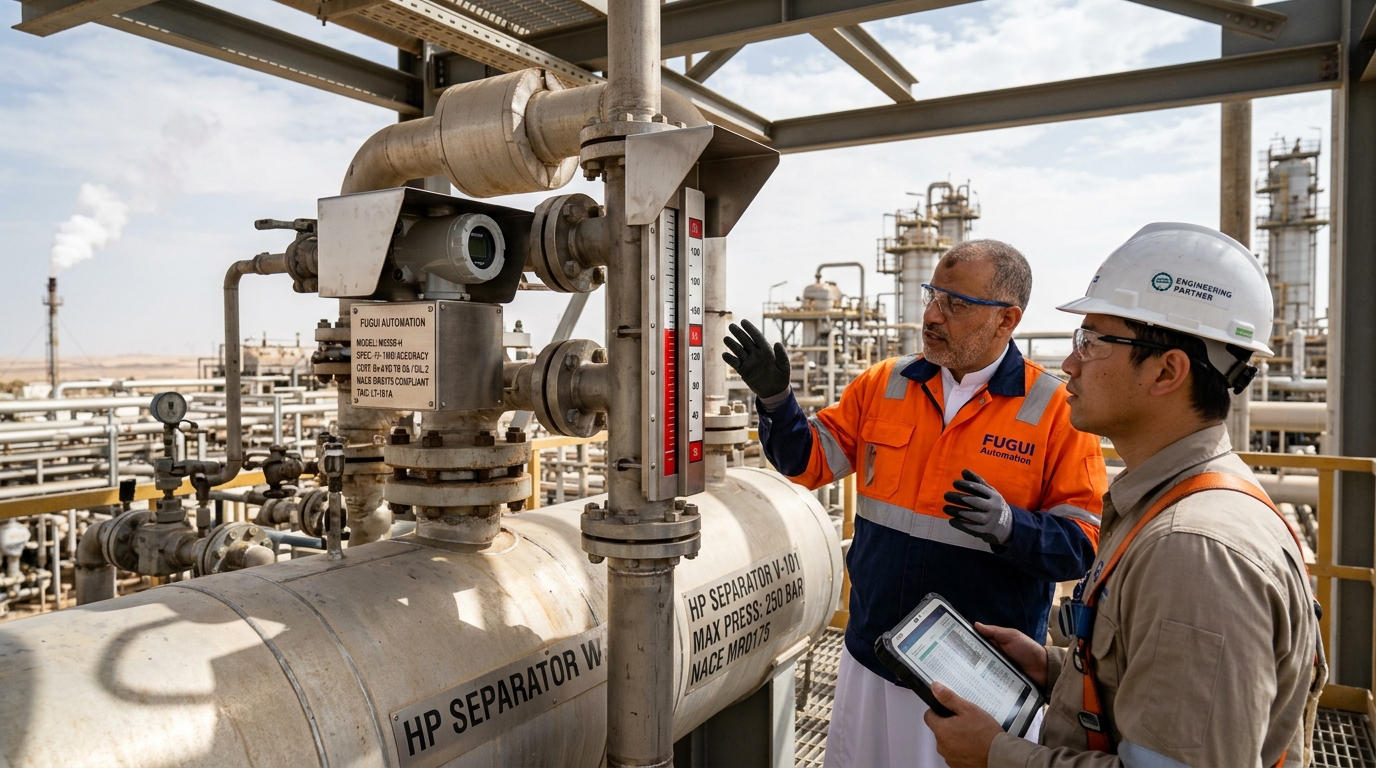
Focus Products: SIC MBS Series Magnetic Level Gauge & SIC MS Series Magnetostrictive Transmitter
Author: Senior Application Engineering Team, FUGUI Automation
Target Sector: Downstream Refining, Upstream Separation Units, Gas Processing Plants (GCC Region)
1. The Operational Challenge in Gulf Process Facilities
Operating processing facilities in the Middle East—spanning Saudi Arabia’s Eastern Province, Abu Dhabi’s onshore/offshore blocks, and Qatar’s gas fields—presents a combination of thermal and mechanical stress rarely matched elsewhere. Ambient shade temperatures routinely cross 50°C, while solar radiation heats exposed instrument enclosures well beyond 75°C. Inside the process pipework, operating conditions are even harsher: steam methane reformers, high-pressure separator vessels, and amine sweetening columns run under pressures exceeding 30 MPa (4,300 psi) and process temperatures ranging from cryogenic LNG service (-190°C) up to 425°C.
For instrument engineers, liquid level measurement in these vessels represents a high-risk failure point. Standard guided wave radar (GWR) units often suffer from signal attenuation caused by dielectric constant shifts at high pressures or heavy vapor blankets. Visual sight glasses present significant containment risks, high maintenance overheads, and severe safety hazards when handling sour gas (H₂S) or toxic hydrocarbons.
To eliminate sight-glass leakage risks and overcome radar signal degradation in dense vapor phases, process control teams rely on a dual-technology selection strategy: Bypass Magnetic Level Gauges (MLG) paired with Continuous Magnetostrictive Level Transmitters.
2. Mechanical Containment & Visual Indication: The SIC MBS Series
Direct vessel penetration for level measurement creates operational risk. The SIC MBS Series Side-Mounted Magnetic Level Gauge acts as an isolated bypass chamber mounted directly to the process vessel via ASME B16.5 flanged connections. The underlying physics relies on hydrostatic pressure balancing between the tank and the chamber, combined with magnetic coupling.
Inside the non-magnetic chamber (typically 316L, Hastelloy C-276, or Titanium Grade 2), a custom-engineered float containing a 360-degree magnetic ring rises and falls with the fluid interface. Mounted on the outside of the chamber—completely isolated from process pressure and media—is a display flange containing two-color magnetic flappers. As the internal float moves, its magnetic field rotates the external flappers 180 degrees, switching them from white (vapor phase) to red (liquid phase).
Key Engineering Specifications for Gulf Environments:
- Maximum Operating Pressure: Up to 42 MPa (420 bar / Class 2500 rating), preventing mechanical yield under extreme surge pressures during ESD (Emergency Shut-Down) cycles.
- Thermal Operating Range: Wide-spectrum capability from -190°C (cryogenic ethylene/LNG) up to +425°C (viscous crude distillation residue).
- Chamber & Float Metallurgy: Standard construction in SS316L; optional NACE MR0175 / ISO 15156 compliant alloys (Inconel 625, Hastelloy C) for sour gas service containing elevated H₂S and CO₂ concentrations.
- Ingress Protection & Visibility: IP68-sealed display assemblies with hermetically glass-sealed indicators to eliminate internal condensation, fogging, and sand ingress caused by desert shamal winds.
3. High-Precision Continuous Signal Output: The SIC MS Series
While the MBS Series provides visual indication, modern distributed control systems (DCS)—such as Yokogawa CENTUM VP or Honeywell Experion—require continuous, high-accuracy electrical signals for closed-loop inventory control and overfill protection. Mounting an external magnetostrictive transmitter onto the MBS bypass chamber provides a 2-in-1 measurement solution without adding extra vessel nozzles.
The SIC MS Series High-Precision Magnetostrictive Liquid Level Transmitter utilizes time-of-flight magnetostriction to deliver absolute position sensing.
An electronic circuitry module sends a high-speed current pulse down a magnetostrictive wire inside the sensor stem. When this current pulse meets the magnetic field generated by the float inside the MBS chamber, a mechanical strain wave (torsional wave) is induced via the Wiedemann effect. This ultrasonic wave travels back along the wire to the sensor head at a known speed. The electronics module measures the exact time delay between the initial current pulse and the return strain wave, calculating the liquid level with millimeter-level precision.
Technical Capabilities & Accuracy Performance:
- Linearity & Accuracy: Repeatable measurement precision down to ±1 mm (0.039 inches), making it ideal for custody transfer, fiscal metering assistance, and precise chemical batching.
- Dual Interface Capabilities: Capable of tracking total level and liquid-liquid interface simultaneously using two distinct floats (e.g., oil-water separation in crude desalting units).
- Communications & Protocol Integration: Standard 4–20 mA loop-powered output with HART 7 protocol support, allowing remote calibration, diagnostic readouts, and configuration via handheld field communicators or DCS asset management platforms.
- Hazardous Area Certification: Flameproof and Ex d IIC T6 Gb explosion-proof enclosures engineered to operate safely in Zone 0, Zone 1, and Class I, Div 1 classified process areas.
4. Application Matrix & Selection Decision Framework
Selecting the appropriate combination of level instrumentation depends on process temperature, pressure, medium viscosity, and process containment requirements. Use the engineering decision matrix below for specifying level instrumentation in GCC refinery and gas processing applications:
| Process Application | Primary Risk Factors | Recommended Instrument Setup | Key Selection Criteria |
|---|---|---|---|
| High-Pressure Separator Vessels | Pressure surges (>150 bar), explosive hydrocarbon vapor, H₂S presence | SIC MBS Gauge + SIC MS Magnetostrictive Transmitter (HART) | NACE MR0175 material compliant; Class 1500/2500 flange rating; Ex d explosion-proof certification. |
| Amine Sweetening & Glycol Dehydration | Corrosive chemicals, variable fluid density, high thermal cycling | SIC MBS (316L/Hastelloy) + Optional Magnetic Switches | Chamber corrosion allowance; high-temperature float design; magnetic limit switches for high/low alarm interlocking. |
| Sump Tanks & Open Slop Tanks | Aggressive ambient sand, sludges, fluctuating fluid clarity | Top-Mounted SIC MS Magnetostrictive Transmitter | Sturdy SS321 or 316L probe rod; non-contact sensing element unaffected by foam or surface turbulence. |
| LNG Storage & Cryogenic Lines | Extreme low temperatures (-162°C to -190°C), thermal insulation needs | SIC MBS Cryogenic Version with Vacuum-Jacketed Insulation | Extended neck design to keep display away from frost buildup; specialized low-density cryogenic floats. |
5. Installation and Commissioning Best Practices
To ensure long-term operational performance in harsh Middle Eastern plant environments, engineering teams should follow these site installation guidelines:
- Thermal Insulation & Tracing: When installing the MBS Series on high-temperature crude lines or heavy wax-bearing fluids, specified heat tracing (electric or steam) must cover the bypass body while keeping the external magnetic indicator and MS transmitter electronics clear of direct thermal exposure.
- Vibration Isolation: For installations near heavy reciprocating compressors, secure the bypass chamber using intermediate support brackets attached to adjacent structural steelwork to prevent structural fatigue.
- Sunshade Protection: While transmitter electronics are rated for extended operational temperatures, installing custom stainless steel sunshades over the electronics enclosure mitigates extreme solar heating, extending component lifespan and preserving LCD clarity.