
Technical Resource
Why Replacing One Process Instrument Can Become a Small Engineering Project: The Hidden Interfaces MRO Buyers Must Check
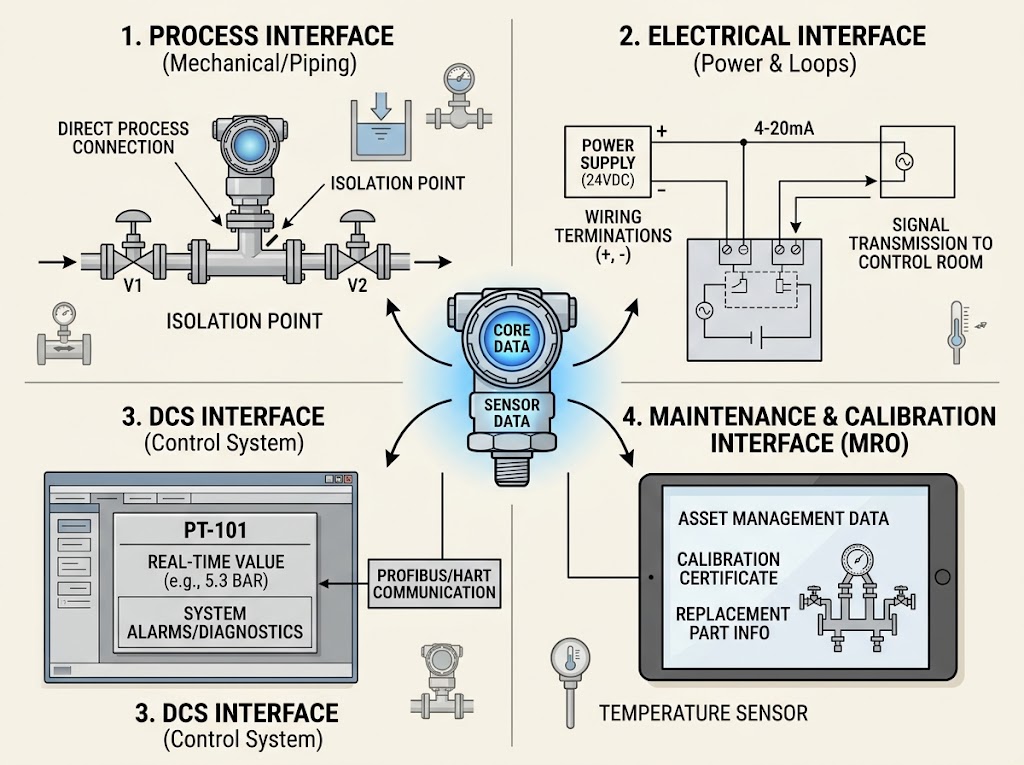
A Replacement Instrument Is Never Just an Instrument
An industrial plant has a failed pressure transmitter.
The maintenance department removes it, takes a photograph of the nameplate and sends the model number to purchasing.
The purchasing team finds the same model—or something described as “equivalent”—and places an order.
At first glance, the job appears finished.
Then the replacement arrives.
The process connection is different.
Or the transmitter body is too large.
Or the cable entry does not match.
Or the output is technically 4–20 mA but the existing loop requires a different configuration.
Or the new flow meter requires installation conditions that do not exist in the plant.
Or the radar level transmitter cannot be installed at the existing nozzle.
Or the DCS module requires a different terminal arrangement.
Suddenly, a $1,000 or $2,000 replacement purchase has become an engineering problem.
This is one of the most underestimated issues in industrial MRO procurement.
A process instrument is not an isolated product. It is an interface between the process, piping, electrical system, control system and maintenance organization.
That is why a technically correct replacement must be evaluated at more than the product level.
This article explains the hidden interfaces that MRO buyers, EPC contractors, instrumentation engineers and plant maintenance teams should check before approving an industrial instrument replacement.
1. The Five Interfaces Behind Every Process Instrument
A useful way to analyze an industrial instrument is to divide its interfaces into five categories:
1. Process interface
What is the instrument measuring?
2. Mechanical interface
How is it physically connected?
3. Electrical interface
How is it powered and wired?
4. Control-system interface
How does it communicate with the DCS, PLC or SCADA system?
5. Operational interface
How will maintenance, calibration and future replacement be handled?
A replacement that works in four areas but fails in one can still create problems.
For example:
A pressure transmitter may have the correct range.
But if the process connection is wrong, it cannot be installed.
A flow meter may have the correct pipe size.
But if the process medium is unsuitable for its measuring principle, it may not provide reliable measurement.
A DCS card may have the correct number of channels.
But if it is not compatible with the installed system generation, it may not be usable.
This is why replacement evaluation should start with interfaces rather than price.
2. Interface No. 1 — Process Connection
The first hidden interface is usually the mechanical connection between the instrument and the process.
Examples include:
- NPT thread;
- BSP thread;
- G thread;
- flanged connection;
- wafer connection;
- sanitary connection;
- compression fitting;
- diaphragm seal;
- remote seal;
- thermowell;
- insertion probe.
Two instruments can have identical measurement specifications while having completely different process connections.
For example:
Instrument A
0–10 bar
4–20 mA
1/2 NPT
Instrument B
0–10 bar
4–20 mA
G1/2
The electrical specification may look identical.
The mechanical connection is not.
A simple mistake at this stage can result in:
- adapter requirements;
- installation delays;
- leakage risk;
- additional machining;
- engineering approval;
- return shipment.
Therefore, process connection should always be part of the replacement comparison.
FUGUI’s pressure measurement instruments can be used when reviewing pressure and differential pressure measurement requirements.
3. Interface No. 2 — Pressure Class and Mechanical Rating
A process connection is not only about size.
The pressure rating also matters.
A flange may be:
- PN10;
- PN16;
- PN25;
- PN40;
- Class 150;
- Class 300;
- Class 600.
A thread connection also has its own pressure and application limitations.
The MRO buyer should therefore avoid writing:
DN100 flange.
A more useful specification is:
DN100, EN 1092-1, PN16.
For a pressure transmitter with a threaded process connection, the specification may need:
1/2 NPT female, pressure rating suitable for the application.
For a flow meter, the flange standard and pressure class should be confirmed against the existing piping.
This is especially important when an instrument is being installed during a shutdown.
The plant may not have the time or flexibility to modify piping.
4. Interface No. 3 — Face-to-Face Dimension
Face-to-face dimensions are often ignored during procurement.
They should not be.
This is particularly important for inline flow meters.
Suppose the existing meter has a particular face-to-face length.
The replacement meter is slightly longer.
The plant may suddenly need:
- pipe modification;
- additional spool;
- flange adjustment;
- new gasket arrangement;
- additional installation labor.
For an operating plant, these changes can create significant schedule problems.
Therefore, when replacing an inline flow meter, compare:
- nominal diameter;
- flange standard;
- pressure class;
- face-to-face dimension;
- installation orientation;
- grounding;
- cable entry.
FUGUI’s flow measurement solutions cover multiple flow measurement technologies, but the final replacement selection should always consider the existing piping installation.
5. Interface No. 4 — Electrical Power Supply
The electrical supply is another common source of replacement problems.
Typical industrial instrument power supplies include:
- 24 VDC;
- 12 VDC;
- 110 VAC;
- 220 VAC;
- loop-powered supply.
The fact that an instrument has a 4–20 mA output does not automatically tell you the power requirements.
A replacement transmitter may require:
- different minimum supply voltage;
- different loop resistance;
- different wiring;
- separate power supply;
- different terminal arrangement.
Before replacement, confirm the actual loop architecture.
For example:
Transmitter → Barrier → Junction Box → AI Card
is different from:
Transmitter → AI Card
The presence of a barrier or isolator can affect the acceptable electrical characteristics.
6. Interface No. 5 — Active vs Passive 4–20 mA
This deserves special attention.
Many procurement teams see:
Output: 4–20 mA
and assume the instruments are interchangeable.
They are not necessarily interchangeable.
The loop may be:
- active;
- passive;
- loop powered;
- externally powered.
The supplier should therefore confirm the complete electrical configuration.
For a replacement request, provide:
- supply voltage;
- signal type;
- loop arrangement;
- barrier type;
- input card;
- wiring arrangement.
If the existing instrument is available, a photograph of the terminal wiring can be extremely useful.
7. Interface No. 6 — HART and Digital Communication
Modern process transmitters often provide:
- 4–20 mA;
- HART;
- Modbus;
- PROFIBUS PA;
- FOUNDATION Fieldbus;
- other digital communication.
A replacement instrument may still provide 4–20 mA while changing the digital communication capability.
That difference can matter.
For example, the plant may use HART for:
- remote configuration;
- diagnostics;
- range adjustment;
- status information;
- maintenance.
If the replacement does not support the required communication method, the basic analog signal may still work while the plant loses important functionality.
Therefore:
Analog compatibility does not automatically mean full system compatibility.
8. Interface No. 7 — DCS and PLC Compatibility
The instrument eventually connects to a control system.
That system could be:
- DCS;
- PLC;
- SCADA;
- RTU;
- remote I/O;
- local control panel.
The replacement must be evaluated against the existing I/O architecture.
For example:
Field Instrument
↓
Junction Box
↓
Marshalling Cabinet
↓
Barrier / Isolator
↓
I/O Module
↓
DCS
Changing the field instrument can affect the signal interface at several points.
For DCS spare parts, the same principle applies.
A module should be checked against:
- DCS model;
- system generation;
- module type;
- part number;
- revision;
- terminal arrangement;
- base unit;
- communication architecture.
FUGUI’s Yokogawa DCS spare parts portfolio is relevant for projects involving replacement or sourcing of Yokogawa DCS modules.
9. Interface No. 8 — Hazardous-Area Certification
For instruments installed in hazardous locations, certification is part of the engineering requirement.
Depending on the project and jurisdiction, the instrument may need specific certification such as:
- ATEX;
- IECEx;
- UL;
- FM;
- CSA;
- other project-specific approvals.
The exact certification required depends on the installation.
A replacement instrument without the required certification may be technically functional but unacceptable for the site.
This is why:
“Same range + same output”
is not enough.
The buyer should also compare the certification.
For MRO procurement, the certification marking on the existing instrument can provide useful information.
Take a clear photograph of the nameplate before requesting a replacement.
10. Interface No. 9 — Process Temperature
Temperature affects far more than temperature sensors.
A pressure transmitter may be exposed to high process temperature.
A flow meter may operate with hot fluid.
A level transmitter may be installed on a vessel with elevated temperature.
The instrument specification should therefore distinguish between:
Process temperature
and
Ambient temperature.
They are not the same.
For remote-seal pressure transmitters, the temperature behavior of the seal and capillary assembly may also need to be considered.
For temperature instruments themselves, the sensor element, thermowell and transmitter must be evaluated as a complete assembly.
FUGUI’s temperature measurement products include industrial temperature sensors and transmitters.
11. Interface No. 10 — Process Medium and Wetted Materials
The process medium determines whether the instrument’s wetted materials are suitable.
Potential considerations include:
- corrosion;
- chemical compatibility;
- concentration;
- conductivity;
- viscosity;
- solids;
- abrasiveness;
- crystallization;
- scaling.
For pressure instruments, diaphragm and wetted material are important.
For electromagnetic flow meters, electrode and liner materials matter.
For level instruments, antenna or probe material may matter.
For temperature sensors, sheath and thermowell material can become critical.
A replacement with the same mechanical size but different wetted materials may therefore require engineering review.
12. Interface No. 11 — Flow Meter Installation Conditions
Flow meters are particularly sensitive to installation.
Depending on the technology, installation conditions can include:
- straight pipe length;
- upstream fittings;
- downstream fittings;
- valves;
- pumps;
- pipe bends;
- reducers;
- partially filled pipe;
- flow direction;
- grounding;
- sensor orientation.
This means a flow meter replacement should not be evaluated only from the product datasheet.
The installation itself must also be considered.
For example, if the existing installation has limited straight pipe length, simply replacing the meter with another technology may create a new measurement problem.
The procurement team should therefore provide installation information whenever possible.
13. Interface No. 12 — Tank Geometry for Level Instruments
Level transmitters have another hidden interface:
the tank.
For radar and ultrasonic instruments, the physical tank geometry can influence the application.
Important information includes:
- tank height;
- nozzle height;
- nozzle diameter;
- nozzle position;
- internal structures;
- agitator;
- heating coil;
- ladder;
- support structures;
- foam;
- vapor;
- dust;
- turbulence.
A replacement radar level transmitter should therefore be evaluated against the actual vessel.
FUGUI’s level measurement instruments include radar and ultrasonic level measurement solutions.
For difficult level applications, photographs of the tank nozzle and internal arrangement can be as valuable as the old instrument model number.
14. Interface No. 13 — Calibration and Configuration
A replacement instrument may arrive with the correct hardware but still require configuration.
Examples include:
- measurement range;
- engineering unit;
- damping;
- output behavior;
- alarm settings;
- sensor parameters;
- communication address;
- display configuration.
For smart transmitters, configuration can be particularly important.
The supplier should clarify whether the product is:
- factory configured;
- standard configuration;
- customer configured;
- pre-calibrated.
For critical instruments, request a configuration sheet where appropriate.
This can reduce commissioning time.
15. Interface No. 14 — Physical Dimensions and Maintenance Access
Two instruments may have the same process connection but different body dimensions.
This can create another problem.
The replacement may physically fit the process connection but interfere with:
- pipe;
- cable tray;
- insulation;
- nearby valve;
- structural steel;
- enclosure;
- maintenance access.
For a plant operating in a congested area, this matters.
When replacing an existing instrument, compare:
- overall height;
- overall width;
- mounting holes;
- bracket;
- cable entry;
- display position;
- service clearance.
A photograph of the existing installation can help the supplier identify potential dimensional conflicts.
16. Interface No. 15 — Cable Entry and Wiring
Cable entry is a small detail that can stop an installation.
Common requirements include:
- M20;
- M25;
- 1/2 NPT;
- 3/4 NPT;
- cable gland;
- conduit entry.
The replacement housing may use a different cable-entry arrangement.
This can require:
- new glands;
- adapters;
- reducers;
- additional sealing;
- rewiring.
In hazardous areas, cable-entry components may also need to comply with the relevant certification requirements.
Therefore, cable entry should be included in the replacement specification.
17. Interface No. 16 — Environmental Protection
Industrial instruments are exposed to real operating environments.
Consider:
- rain;
- dust;
- humidity;
- salt spray;
- vibration;
- outdoor sunlight;
- chemical vapors;
- temperature cycling.
IP rating is one part of the evaluation.
Other environmental requirements may also matter.
For an outdoor transmitter, for example, the buyer should check:
- enclosure;
- cable entry;
- corrosion resistance;
- ambient temperature;
- mounting arrangement.
For instruments installed in coastal or chemical environments, material selection can be especially important.
18. Interface No. 17 — Documentation and Traceability
A replacement is not complete when the instrument arrives.
The plant may need to update:
- equipment records;
- instrument index;
- calibration records;
- maintenance database;
- spare-parts database;
- drawings;
- commissioning records.
Therefore, the supplier’s documentation can become part of the plant’s long-term maintenance system.
For critical instruments, request:
- datasheet;
- serial number;
- calibration certificate;
- test report;
- certificate of conformity;
- manual;
- wiring diagram;
- product photograph.
This is particularly important when purchasing obsolete or surplus equipment.
19. Interface No. 18 — Spare Parts Strategy
One replacement can create a second procurement problem.
Suppose a plant replaces an obsolete pressure transmitter with a new model.
The new model works.
But the maintenance department still has ten old units in service.
Now the plant has two different spare-part families.
This can increase:
- inventory complexity;
- training requirements;
- documentation;
- calibration procedures;
- maintenance workload.
Therefore, replacement decisions should consider the wider installed base.
Ask:
Is this replacement an isolated repair, or is it the beginning of a technology transition?
That question can change the procurement strategy.
20. Interface No. 19 — Product Condition
For MRO and obsolete equipment, product condition must be clearly defined.
Possible categories include:
- factory new;
- original new stock;
- new surplus;
- unused obsolete stock;
- refurbished;
- repaired;
- tested used;
- equivalent alternative.
These categories should not be treated as interchangeable.
If the customer requires factory-new equipment, the supplier should state that clearly.
If the customer accepts refurbished equipment for an obsolete DCS module, that should also be stated clearly.
Condition affects:
- price;
- warranty;
- availability;
- risk;
- documentation.
21. Interface No. 20 — Logistics and Packaging
Industrial instruments can be small but still require careful logistics.
Consider:
- export packaging;
- moisture protection;
- shock protection;
- instrument preservation;
- nameplate protection;
- serial-number records;
- shipping marks.
For international shipments, the supplier may also need to provide:
- commercial invoice;
- packing list;
- certificate of origin where required;
- export documentation;
- freight information.
For urgent MRO orders, logistics can be almost as important as manufacturing lead time.
An instrument that is “available” but cannot be shipped for another week is not necessarily an emergency solution.
22. A Practical Compatibility Matrix
Before approving a replacement, use a compatibility matrix.
| Interface | Existing | Proposed | Status |
|---|---|---|---|
| Measurement principle | Existing | Proposed | Check |
| Range | 0–10 bar | 0–10 bar | Confirmed |
| Process connection | 1/2 NPT | 1/2 NPT | Confirmed |
| Pressure rating | Required | Proposed | Check |
| Process temperature | 100°C | 120°C | Confirmed |
| Output | 4–20 mA | 4–20 mA | Confirmed |
| Communication | HART | HART | Confirmed |
| Power supply | 24 VDC | 24 VDC | Confirmed |
| Certification | Required | Proposed | Check |
| Dimensions | Existing | Proposed | Check |
| Cable entry | M20 | M20 | Confirmed |
| DCS compatibility | Existing | Proposed | Check |
| Documentation | Required | Proposed | Check |
The purpose is not to create paperwork.
The purpose is to make unknowns visible.
23. What a Supplier Should Ask Before Recommending an Alternative
A professional supplier should not immediately recommend a model based on one parameter.
For example, if the customer asks:
Need a replacement pressure transmitter, 0–16 bar.
The supplier should ask:
- What is the medium?
- Gauge or absolute pressure?
- What is the process temperature?
- What is the process connection?
- What is the output?
- What is the power supply?
- Is HART required?
- Is hazardous-area certification required?
- Is local display required?
- Is it an exact replacement or equivalent acceptable?
- What quantity is required?
- What delivery is required?
These questions may feel slower initially.
They are usually much faster than correcting a wrong quotation later.
24. How to Handle an Emergency MRO Requirement
During an emergency shutdown, there may not be time for a complete engineering study.
A practical emergency workflow is:
First
Photograph the existing instrument.
Second
Record the complete model number.
Third
Confirm the application and process conditions.
Fourth
Confirm the mechanical and electrical interfaces.
Fifth
Tell the supplier exactly how quickly the instrument is required.
Sixth
Ask the supplier to classify the offer:
- exact replacement;
- manufacturer successor;
- equivalent;
- refurbished;
- surplus;
- alternative technology.
Seventh
Request technical deviations.
This allows procurement to balance speed with technical control.
25. The Three Questions That Prevent Most Replacement Mistakes
Before ordering an industrial instrument, ask:
Question 1
Will it measure the process correctly?
This covers the measurement principle, range, accuracy and process conditions.
Question 2
Will it physically and electrically fit the existing installation?
This covers process connection, dimensions, wiring, power supply and signal.
Question 3
Will the plant’s control and maintenance systems accept it?
This covers DCS/PLC compatibility, communication, configuration, certification and documentation.
If the answer to all three is clear, the replacement is much easier to control.
26. When the Cheapest Replacement Becomes the Most Expensive Option
Consider a hypothetical example.
An existing flow meter needs replacement.
Supplier A quotes:
$1,200
Supplier B quotes:
$1,450
Supplier A appears cheaper.
However, after technical review:
Supplier A
- different face-to-face dimension;
- adapter required;
- different cable entry;
- additional installation work;
- technical deviation.
Supplier B
- same dimensions;
- same flange standard;
- compatible wiring;
- required documentation included;
- direct installation.
The equipment price difference is $250.
But the total replacement cost may be very different.
This is why industrial MRO procurement should consider:
purchase price + installation impact + engineering impact + downtime risk.
27. Replacement Does Not Always Mean “Same Product”
Sometimes the correct engineering decision is to replace the function with a different technology.
For example:
An old mechanical level measurement system may have frequent maintenance problems.
The plant could consider:
- radar;
- ultrasonic;
- guided wave radar;
- differential pressure level measurement.
The appropriate choice depends on the application.
Likewise, an old flow measurement installation might be evaluated against:
- electromagnetic;
- ultrasonic;
- vortex;
- Coriolis;
- differential pressure.
FUGUI’s flow measurement portfolio provides several technology categories for this type of application review.
The important point is:
Technology substitution is an engineering decision, not simply a purchasing decision.
28. How EPC and MRO Teams Can Work Better With Suppliers
The best supplier relationships are not based only on price.
For technically complex instruments, communication quality matters.
A useful supplier should be able to:
- read an instrument datasheet;
- interpret model codes;
- identify missing parameters;
- explain technical deviations;
- compare alternatives;
- provide documentation;
- confirm availability;
- support urgent sourcing.
This is especially valuable for international projects where the EPC contractor may be purchasing equipment from another country.
The supplier effectively becomes an extension of the procurement and engineering team.
29. Recommended Industrial Instrument Replacement Workflow
A practical workflow is:
1. Identify
Existing manufacturer + model + tag.
↓
2. Photograph
Nameplate + complete instrument + installation.
↓
3. Document
Process + mechanical + electrical requirements.
↓
4. Evaluate
Exact replacement + successor + alternative.
↓
5. Compare
Technical compatibility matrix.
↓
6. Verify
DCS/PLC + certification + installation.
↓
7. Quote
Price + stock + lead time + warranty.
↓
8. Approve
Engineering + procurement.
↓
9. Purchase
Complete configuration.
↓
10. Inspect
Model + quantity + documentation.
↓
11. Install
Mechanical + electrical.
↓
12. Commission
Configuration + calibration + loop test.
This process works for both individual emergency replacements and larger MRO procurement programs.
30. Industrial Instrument Replacement Checklist
Before placing the order, confirm:
Process
- Medium identified
- Measurement principle confirmed
- Range confirmed
- Pressure confirmed
- Temperature confirmed
- Flow / level conditions confirmed
Mechanical
- Connection confirmed
- Flange standard confirmed
- Pressure class confirmed
- Face-to-face confirmed
- Dimensions confirmed
- Materials confirmed
- Installation orientation confirmed
Electrical
- Power supply confirmed
- 4–20 mA configuration confirmed
- Active/passive confirmed
- Communication confirmed
- Cable entry confirmed
- Wiring confirmed
Control
- DCS/PLC confirmed
- I/O compatibility confirmed
- Configuration confirmed
- Addressing confirmed where applicable
Compliance
- Hazardous-area certification
- IP rating
- Required project standards
- Calibration
- Inspection
Commercial
- Exact / successor / equivalent defined
- Product condition defined
- Quantity confirmed
- Price confirmed
- Stock confirmed
- Lead time confirmed
- Warranty confirmed
Documentation
- Datasheet
- Drawing
- Certificate
- Test report
- Calibration certificate
- Manual
31. Final Takeaway
A failed instrument may be a small physical object.
The engineering interfaces around it are not.
A pressure transmitter connects the process to the control loop.
A flow meter connects the piping system to the measurement system.
A radar level transmitter connects the vessel geometry to the control system.
A temperature sensor connects the process temperature to the electrical signal.
A DCS module connects the field signal to the plant automation architecture.
That is why replacing one instrument can sometimes become a small engineering project.
The safest approach is to evaluate the complete interface chain:
Process → Mechanical → Electrical → Control → Certification → Configuration → Documentation → Maintenance
Do not evaluate the replacement only by:
- model number;
- measurement range;
- unit price.
Evaluate whether it will actually work in the existing plant.
For MRO buyers, EPC procurement teams and industrial maintenance departments, this approach can reduce:
- wrong deliveries;
- installation modifications;
- commissioning delays;
- technical clarification;
- emergency freight;
- spare-parts complexity;
- unnecessary downtime.
And for international procurement, it makes one more thing possible:
a supplier can understand the real requirement before recommending a product.
Request a Replacement Instrument Review
If you are sourcing a replacement pressure transmitter, flow meter, level transmitter, temperature sensor, water-quality instrument or DCS spare part, provide:
Existing model + nameplate photograph + application + process conditions + connection + output + quantity + required delivery date.
FUGUI Automation can review the available information and help determine whether the requirement should be handled as:
- an exact replacement;
- a manufacturer successor;
- an equivalent alternative;
- or a different measurement technology.
Send your instrument details for technical review and quotation.
Frequently Asked Questions
Why is industrial instrument replacement more complicated than buying a new instrument?
Because a replacement must work with an existing process, piping system, electrical loop, control system and installation environment. A new project has more freedom to design these interfaces from the beginning.
What should I check before replacing a pressure transmitter?
Check pressure type, range, process medium, process temperature, process connection, pressure rating, wetted materials, output, communication, power supply, certification and physical dimensions.
Can I replace any 4–20 mA transmitter with another 4–20 mA transmitter?
No. Active/passive configuration, power supply, loop resistance, HART communication, barriers, wiring and control-system input characteristics also need to be checked.
What should I check when replacing a flow meter?
Check medium, minimum/normal/maximum flow, pressure, temperature, pipe size, flange standard, pressure class, face-to-face dimension, lining, sensor materials, output, power supply and installation conditions.
What information is needed to replace a radar level transmitter?
Tank height, measurement range, process medium, temperature, pressure, nozzle size, nozzle position, internal structures, agitator, foam, vapor and existing mounting arrangement are useful.
How do I know if a DCS module is compatible?
Confirm the DCS manufacturer, system generation, complete module part number, revision, module type, terminal arrangement and related hardware. Do not select a DCS module only from its general description.
Should an obsolete instrument always be replaced with the same model?
Not necessarily. An exact replacement, manufacturer successor, equivalent product or new technology may all be possible depending on technical requirements and project approval.
What is the most important information to send a supplier?
The complete existing model number and a clear nameplate photograph are extremely useful. Add the application, process conditions, connection, signal, quantity and required delivery date.