
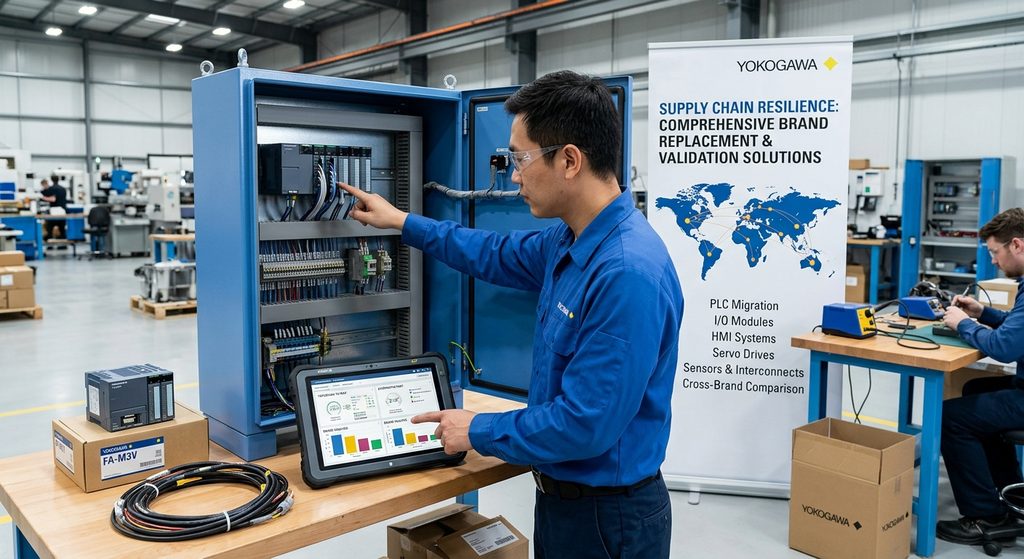
In high-stakes manufacturing, an unplanned line stoppage is every plant manager and procurement engineer’s worst nightmare. Whether triggered by legacy component obsolescence, sudden lead-time spikes from traditional Tier-1 vendors, or broader geopolitical supply chain reshuffling, the result remains identical: active production lines sit idle while downtime costs accumulate by the hour.
For system integrators and procurement specialists managing complex industrial automation environments, relying on a single, rigid sourcing pathway is no longer a viable strategy. True supply chain resilience requires a proactive framework for cross-referencing, functional substitution, and strategic migration.
Here is an engineering-first blueprint for navigating market disruptions, maintaining operational uptime, and building a flexible component pipeline.
The Reality of Today’s Industrial Automation Bottlenecks
Industrial automation relies heavily on trusted OEMs for Programmable Logic Controllers (PLCs), Human-Machine Interfaces (HMIs), variable frequency drives (VFDs), and servo systems. However, global distribution networks are increasingly vulnerable to multi-factor disruptions:
- Unpredictable Lead Times: Extended lead times on standard digital and analog I/O modules can halt entire capital expenditure (CapEx) projects.
- Aggressive EOL (End-of-Life) Cycles: Manufacturers routinely phase out legacy lines, forcing unexpected upgrade cycles on legacy machinery that otherwise performs reliably.
- Geopolitical & Freight Friction: Shifted trade routes, localized compliance barriers, and regional inventory reallocations often restrict access to standard regional warehouses.
When a crucial drive or controller becomes unavailable through conventional channels, waiting months for direct factory allocation is rarely an option. Engineering procurement teams need immediate, technically sound alternatives.
Step-by-Step Framework for Executing a Safe Component Replacement
Replacing a core automation component is not as simple as swapping like-for-like hardware. A haphazard replacement risks protocol mismatches, software incompatibility, or hardware damage. Industrial buyers should execute swaps using a systematic three-phase validation workflow.
Phase 1: Electrical Parameters & Pinout Mapping
Before evaluating brand or software, confirm the underlying electrical profile matches the existing enclosure setup:
- Operating Voltage & Tolerances: Ensure primary supply voltages (e.g., 24V DC nominal) match operational ranges, including transient surge limits.
- I/O Densities & Ratings: Match sinking vs. sourcing (NPN/PNP) configurations, relay contact limits, and response speeds for high-speed counter inputs.
- Backplane Power Draw: Verify that alternative expansion modules will not overload the existing CPU rack or power supply module.
Phase 2: Industrial Communication Protocol Compatibility
Modern smart factories depend heavily on industrial Ethernet and fieldbus networks. A replacement module must seamlessly integrate into the host system without requiring a complete rewrite of the master PLC architecture.
- Deterministic Fieldbus Protocols: Verify native support for PROFINET, EtherNet/IP, EtherCAT, or Modbus TCP/RTU.
- Configuration Files: Ensure device description files—such as GSDML for PROFINET or EDS for EtherNet/IP—are readily available to map I/O bytes directly into existing engineering software suites (e.g., TIA Portal, Studio 5000, or CODESYS).
- Gateway Interoperability: If direct protocol substitution is impossible, evaluate compact hardware protocol gateways to translate communications without introducing excessive latency.
Phase 3: Physical Form Factor and Thermal Dynamics
- DIN-Rail & Mounting Dimensions: Physical cabinet space is fixed. Verify depth, height, and mounting orientation.
- Thermal Dissipation: Alternative VFDs or servo drives may generate different heat profiles. Confirm cabinet cooling capacity and required clearance distances around cooling fins.
Direct Cross-Referencing vs. Functional Equivalents
When sourcing replacement hardware during supply pinches, procurement teams generally choose between two core sourcing paths:
| Feature / Criteria | Exact Match / Drop-In Replacement | Functional Equivalent / Alternative Brand |
| Sourcing Speed | Dependent on current open market stock | High availability via domestic/alternative channels |
| Engineering Effort | Near zero (direct swap) | Low-to-moderate (GSD/EDS mapping, wiring check) |
| Cost Profile | Standard market rate (or markup during shortages) | Optimized unit costs and reduced long-term TCO |
| Long-Term Risk | High if the underlying product is near EOL | Low; establishes a multi-vendor sourcing model |
When to Choose Direct Drop-In Hardware
Exact part-number matching makes sense for sealed machinery where control logic cannot be recompiled, or where strict regulatory compliance prohibits modifying controller configurations. In these cases, working with independent automation distributors who maintain active, verified surplus and ready-to-ship new-in-box inventory is the fastest route to restoration.
When to Opt for Functional Migration
For new system builds, retrofit projects, or flexible PLC architectures, migrating to high-performance alternative brands (such as top-tier domestic Chinese automation controllers) offers a distinct strategic edge. Modern industrial controllers built on open-architecture standards (like CODESYS-compliant environments) match international execution speeds, provide robust fieldbus support, and offer drastically shorter lead times.
Mitigating Sourcing Risks in the Open Market
When stepping outside authorized regional distribution networks to find immediate inventory, procurement managers must mitigate quality and counterfeiting risks. Establishing a rigorous vendor verification protocol is crucial:
- Serial Tracking & Physical Inspection: Ensure suppliers provide high-resolution physical photos, batch tracking numbers, and original factory seals prior to shipment.
- Functional Bench Testing: Partner with suppliers who operate internal testing rigs to verify PLC I/O channel responsiveness, communication port handshakes, and firmware integrity before dispatch.
- Transparent Logistics & Express Dispatch: Verify that your supplier understands critical international freight pathways—utilizing priority air freight and clear customs classification codes (HS Codes) to prevent delays at entry points.
Build a Resilient Automation Pipeline Today
Securing your production line requires more than waiting on backordered factory allocations. Whether you require immediate stock of hard-to-find international automation series or technical guidance on migrating your control architecture to reliable, cross-compatible alternatives, having the right technical partner makes all the difference.
Need an immediate stock check or a technical cross-reference match for your BOM (Bill of Materials)?
Send your target part numbers, equipment specs, or project requirements directly to our engineering support team. We will review your pinout and protocol requirements and deliver a functional substitution matrix along with stock availability within 24 hours.