
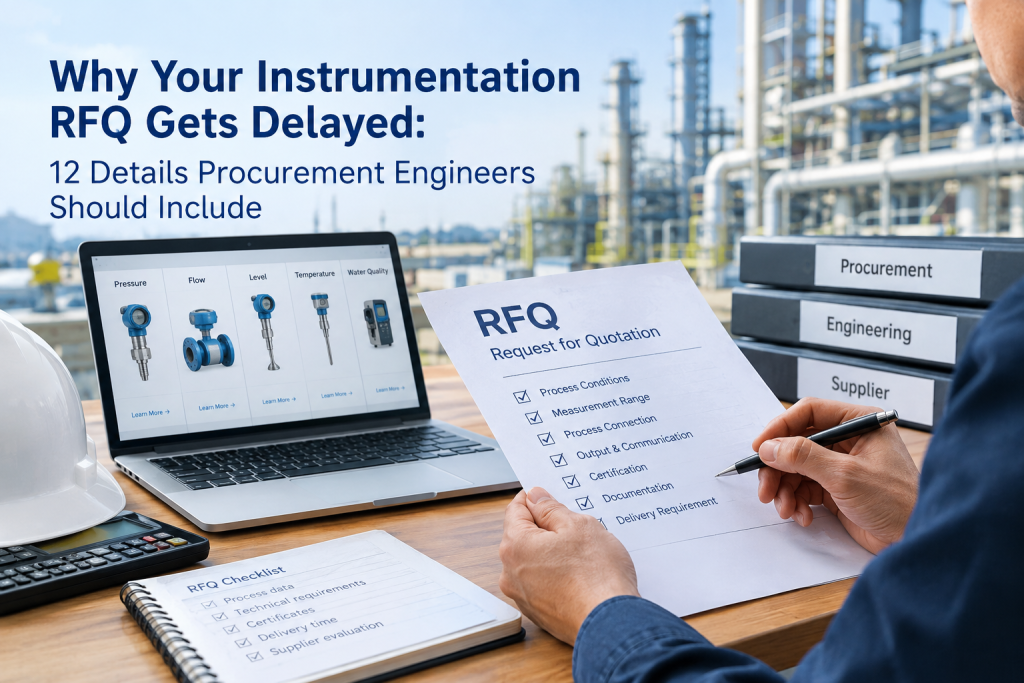
Sometimes the RFQ itself does not contain enough information for a supplier to quote the right configuration.
A request such as:
“Please quote 2 pcs pressure transmitters, 4–20 mA, 0–10 bar.”
looks simple.
But for a process instrumentation supplier, it leaves a surprising number of questions unanswered.
What is the process medium? Is the pressure gauge pressure or absolute pressure? What is the normal operating pressure? What is the maximum pressure? What temperature will the transmitter see? What process connection is required? Is hazardous-area certification necessary? Is HART required? What wetted material is acceptable? Does the project require a particular manufacturer? Are certificates required?
The result is predictable.
The supplier sends a clarification email.
The engineering team replies.
Another question appears.
The supplier revises the quotation.
Procurement compares the new quotation with another quotation that may not even be based on the same configuration.
A simple RFQ can turn into a week-long exchange.
For project procurement, maintenance purchasing and EPC contractors, a better approach is to treat the RFQ as a technical data package, not simply a request for a price.
1. Start with the Process, Not the Model Number
One of the most common mistakes in instrumentation procurement is starting with a model number before defining the measurement duty.
For example, an engineer may know that the plant normally uses an electromagnetic flow meter from a particular manufacturer. The next RFQ therefore begins with:
“Please quote model XXXX.”
That can work for a straightforward replacement.
It becomes risky when the application has changed.
Perhaps the pipe size is different.
Perhaps the medium has changed.
Perhaps the operating flow is lower than the original design.
Perhaps the temperature or conductivity is different.
Perhaps the instrument is being installed in a new location with limited straight pipe.
A model number is useful, but it should not replace process information.
FUGUI’s flow measurement product range follows this principle: the medium, pipe and connection, operating range, process conditions and output should be considered before the final configuration is selected.
This is particularly important for flow meters because the same nominal pipe size can serve completely different applications.
A clean-water line, chemical solution, wastewater line and steam line may all have the same DN100 pipe.
They do not require the same measurement technology.
2. The Medium Is More Important Than Many Buyers Realize
“Water” is not always enough.
A supplier needs to understand what kind of water is being measured and what is mixed with it.
For example:
- Raw water
- RO permeate
- Cooling water
- Wastewater
- Sludge
- Seawater
- Chemical wastewater
- CIP solution
- Boiler feedwater
can create very different measurement requirements.
The same applies to chemicals.
Instead of simply writing “chemical,” provide the actual medium whenever possible.
For liquids, useful information can include concentration, conductivity, viscosity, density and the presence of suspended solids.
For gases, pressure, temperature, composition and density may become important.
For steam, the operating pressure and temperature are particularly important because they affect the measurement conditions and the required configuration.
This is one reason FUGUI’s process measurement inquiry checklist asks for process information rather than relying only on a product name.
The goal is simple:
Give the supplier enough information to identify the correct instrument before discussing price.
3. Give Normal and Maximum Conditions Separately
Another frequent RFQ problem is providing only one operating value.
For example:
Pressure: 10 bar
What does 10 bar mean?
Is it the normal operating pressure?
The maximum pressure?
The design pressure?
The pressure during startup?
These are not interchangeable.
A much more useful RFQ might say:
- Normal pressure: 8 bar
- Maximum operating pressure: 10 bar
- Design pressure: 16 bar
The same principle applies to temperature and flow.
For a flow meter:
- Minimum flow
- Normal flow
- Maximum flow
are often much more useful than simply saying:
Flow: 100 m³/h
A meter that performs well at 100 m³/h may not be appropriate if the actual process regularly falls to 5 m³/h.
The operating window matters.
For more guidance on this issue, see FUGUI’s technical resource on how pressure and temperature affect instrument selection.
4. Pipe Size Is Not the Same as Meter Size
This sounds obvious, but it causes many quotation problems.
An RFQ might say:
DN150 electromagnetic flow meter.
That tells the supplier the pipeline size.
It does not necessarily tell the supplier that the flow meter itself must be DN150.
Depending on the application, installation arrangement and velocity requirements, a different meter size may sometimes need to be considered.
Therefore, a useful RFQ should distinguish between:
Pipeline nominal diameter
and
Required meter size, if already specified by engineering.
If the meter size is mandatory, say so.
If it is open for engineering recommendation, say that instead.
This small distinction prevents suppliers from making assumptions.
5. Process Connection Should Be Written Clearly
“Flange connection” is not enough for many international projects.
A better specification may include:
- DN100
- EN 1092-1
- PN16
or:
- 4 inch
- ASME B16.5
- Class 150
Threaded connections also need attention.
For example:
- 1/2″ NPT
- 1/2″ BSP
- G1/2
are not automatically interchangeable.
If the process connection is already defined by the piping engineer, include it in the RFQ.
If it is not defined, tell the supplier that the connection is subject to technical confirmation.
6. Do Not Forget the Output Signal
“4–20 mA” is common.
That does not mean it is the only information required.
Ask yourself:
- Is HART required?
- Is a digital communication protocol required?
- Is pulse output needed?
- Is local indication required?
- Is remote indication required?
- Does the instrument need to communicate with an existing DCS or PLC?
- Is a particular fieldbus required?
For projects using distributed control systems, communication compatibility can be just as important as the measurement range.
FUGUI also supplies Yokogawa DCS cards and DCS spare parts, so DCS compatibility and replacement requirements can be considered alongside field instrumentation rather than as two completely separate procurement packages.
7. Certification Requirements Should Be Stated Before Quotation
Certification can significantly change the configuration and price.
For example, an instrument installed in a hazardous area may require a particular Ex certification.
Other projects may require:
- SIL documentation
- ATEX
- IECEx
- FM
- CSA
- NEPSI
- Marine approval
- Drinking-water approval
- Food-contact approval
- Material certificates
- Calibration certificates
- Certificate of conformity
If these requirements appear only after the supplier has already quoted, the quotation may need to be completely revised.
That creates unnecessary delays.
If certification is required, put it directly into the RFQ.
If it is not required, say “standard industrial application” where appropriate.
8. Wetted Materials Can Change the Entire Selection
For pressure transmitters, flow meters and level instruments, the process-facing materials matter.
A transmitter may have a suitable measuring range but an unsuitable diaphragm or seal material.
A level instrument may work perfectly in clean water but require a different material when installed in an aggressive chemical tank.
For flow meters, lining and electrode materials can be particularly important when the medium is corrosive or conductive.
This is why an RFQ should not simply say:
“Stainless steel.”
If material compatibility is important, specify the required material or provide the process medium and concentration so that the supplier can recommend it.
FUGUI’s pressure measurement range covers pressure transmitters and differential-pressure instruments for different process applications, but final configuration still depends on the actual operating conditions.
9. Level Measurement Needs Tank Information
Level instruments are especially sensitive to installation conditions.
A request saying:
“Radar level transmitter, 0–10 m”
does not tell the supplier enough.
Useful information includes:
- Tank height
- Measuring range
- Medium
- Density
- Temperature
- Pressure
- Vapor
- Foam
- Agitation
- Internal obstructions
- Nozzle size
- Nozzle length
- Required connection
- Required accuracy
- Hazardous-area requirements
The difference between a quiet water tank and a turbulent chemical vessel can completely change the engineering considerations.
FUGUI’s level measurement product range includes radar and ultrasonic technologies for different liquid and industrial applications.
The important point is not to choose radar simply because “radar is better.”
The correct question is:
What conditions will the instrument actually see?
10. Temperature Instruments Need More Than “RTD”
A surprising number of RFQs contain only:
RTD, Pt100, 4–20 mA.
That may be enough for a very simple replacement.
For a new project, additional information may be needed:
- Sensor type
- Number of wires
- Probe length
- Insertion length
- Thermowell requirement
- Process connection
- Process temperature
- Pressure
- Material
- Accuracy
- Transmitter requirement
- Output signal
- Head-mounted or DIN-rail transmitter
For buyers handling temperature instrumentation, FUGUI’s temperature measurement range provides a starting point for reviewing RTDs, thermocouples and temperature transmitters.
11. Quantity and Delivery Requirement Should Be Clear
Procurement teams sometimes write:
Quantity: 5
and leave everything else open.
But the supplier may need to know whether these five units are:
- For immediate replacement
- For a new project
- For commissioning
- For spare stock
- For future maintenance
The commercial priority can be very different.
If the requirement is urgent, state the required date.
And be careful with the word lead time.
In international industrial procurement, suppliers may use lead time to mean manufacturing or preparation time, while buyers may interpret it as delivery time.
To avoid confusion, write:
Manufacturing lead time: XX weeks
or:
Required delivery date: XX
This makes the procurement expectation much clearer.
12. The Best RFQ Is Usually Not the Longest One
A good RFQ does not need twenty pages.
For many standard instruments, one well-structured page can be enough.
A practical structure is:
Instrument: Electromagnetic Flow Meter
Quantity: 2 pcs
Medium: Cooling water
Pipe size: DN100
Flow: 10–80 m³/h
Normal flow: 45 m³/h
Temperature: 25–45°C
Pressure: 6 bar normal / 10 bar max
Connection: EN 1092-1 PN16
Liner: Supplier recommendation
Electrodes: Supplier recommendation
Output: 4–20 mA + HART
Power supply: 24 VDC
Display: Required
Area classification: Non-hazardous
Certificate: Calibration + CoC
Quantity: 2
Required delivery: Before 15 December
Preferred brand: E+H / Yokogawa / equivalent, subject to approval
This is far more useful than:
“Please quote DN100 flow meter, 2 pcs.”
The Hidden Benefit: Better RFQs Make Supplier Comparison Easier
A complete RFQ does more than speed up quotations.
It also makes supplier comparison fairer.
If Supplier A quotes one configuration and Supplier B quotes another, a lower price does not necessarily mean a better commercial offer.
Before comparing prices, confirm:
- Same measuring principle
- Same measuring range
- Same process connection
- Same wetted materials
- Same output
- Same communication
- Same certification
- Same accessories
- Same documentation
- Same warranty
- Same delivery basis
Only then does the price comparison become meaningful.
For buyers who regularly handle pressure, flow, level, temperature and water-quality instruments, FUGUI’s instrumentation portfolio can be used as a starting point for reviewing the different measurement categories.
A Simple Rule for Your Next RFQ
Before sending an instrumentation inquiry, ask one question:
Could another engineer select the correct instrument from the information in this RFQ without calling me?
If the answer is no, add more process information.
You do not need to know the final model number.
You do not need to know every technical parameter.
You simply need to provide enough information for the supplier to understand the measurement duty and identify what still needs confirmation.
That changes the conversation from:
“What price can you offer?”
to:
“Here is the application. Please recommend and quote the correct configuration.”
The second conversation usually produces a much more useful quotation.
And for procurement engineers, that is the real objective—not simply receiving a price, but receiving a quotation that can actually be compared, approved and ordered.
Need help checking an instrumentation RFQ? Share the instrument model, process medium, operating conditions, quantity and required delivery date. A supplier can then verify the configuration before you commit to the purchase.