
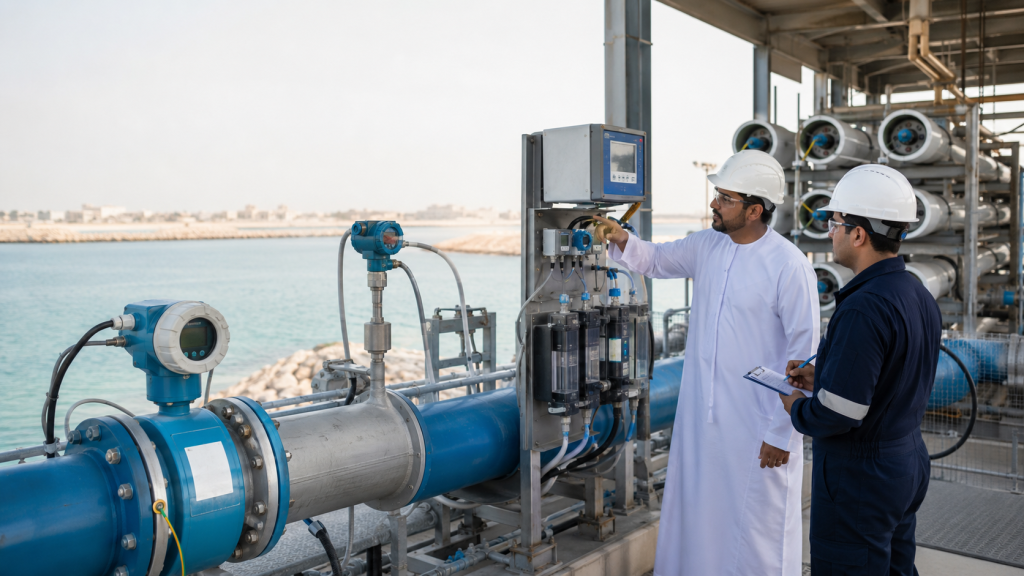
In a seawater reverse-osmosis plant, the instruments are rarely the largest items on the bill of materials. They can still decide whether the plant reaches design output, protects its membranes and reports a credible water balance.
That is particularly true in the Gulf. Intake conditions can change with tides, seasonal temperature, suspended solids and biological activity. Salinity is high. Outdoor electronics face heat, humidity and salt-laden air. Meanwhile, an EPC contractor may be asked to compare instruments from several manufacturers against one datasheet, one approved vendor list and a fixed commissioning date.
The usual procurement mistake is to begin with a familiar model number. A better approach is to begin with the measurement duty. Where is the instrument installed? What will touch the process? What operating condition must it survive? What decision will be made from its reading?
This guide follows the water through a typical seawater reverse-osmosis (SWRO) plant and shows what should be settled before an RFQ is issued.
Start with the measurement point, not the catalogue
“Flowmeter for seawater” is not a complete specification. The flowmeter at the intake header does not perform the same duty as the instrument on a high-pressure RO feed line. A conductivity sensor after remineralisation is not selected in the same way as a brine conductivity sensor. Even two pressure transmitters with the same nominal range may require different wetted materials, process connections and environmental protection.
Before selecting a model, define six items for every measurement point:
- Process medium: raw seawater, clarified water, filtered seawater, high-pressure feed, permeate, product water, chemical solution or concentrated brine.
- Operating window: minimum, normal and maximum flow, pressure and temperature—not only the design maximum.
- Process connection: pipe diameter, flange standard, pressure class, insertion arrangement and available straight run.
- Wetted materials: liner, electrodes, diaphragm, gasket, sensor body and any thermowell or seal.
- Required output: 4–20 mA, HART, pulse, Modbus, PROFIBUS, Ethernet-based protocol or local indication.
- Required evidence: calibration certificate, material certificate, drinking-water approval, hazardous-area approval or project-specific inspection.
This information prevents a common failure in international procurement: receiving a technically recognizable instrument that is nevertheless wrong for the actual installation.
1. Seawater intake: flow, pressure and changing water conditions
The intake is where the plant first establishes its water balance. Flow readings may be used to compare abstraction, pretreatment recovery, RO recovery and final production. A persistent intake measurement error therefore propagates through operating reports and chemical-dose calculations.
Electromagnetic flowmeters are often the first option—but not automatically the final one
Seawater is electrically conductive, so a full-bore electromagnetic flowmeter is often a practical choice. It has no moving parts and introduces no intentional restriction into the pipe. That makes it attractive for large intake and transfer lines where pressure loss and maintenance access matter.
The word “magmeter,” however, does not complete the selection. The buyer still needs to confirm:
- the minimum conductivity required by the selected instrument;
- whether the pipe remains completely full at all operating conditions;
- liner compatibility with seawater, cleaning chemicals and temperature;
- electrode material for the actual chloride exposure;
- grounding arrangement, especially with lined or non-metallic pipe;
- installation distance from pumps, bends, tees and control valves;
- whether the transmitter should be compact or remote-mounted;
- enclosure, sunshade and cable protection for outdoor service.
For existing large-diameter pipelines where shutdown or pipe cutting is difficult, clamp-on ultrasonic measurement may be considered. It can be valuable for surveys, temporary verification and retrofit duties. Its performance depends on pipe material, wall thickness, liner condition, acoustic coupling, fluid profile and installation quality. It should not be specified merely because it is non-intrusive.
Pressure is also a condition indicator
Intake pressure measurements can reveal more than pump discharge pressure. When instruments are located across screens, strainers or filters, the differential trend can indicate fouling and help operators schedule cleaning. The relevant specification is therefore not just maximum static pressure. It includes expected differential range, overpressure during pump transitions, impulse-line layout and the possibility of blocked sensing lines.
At open intakes and low-pressure sections, selecting an unnecessarily wide pressure range can sacrifice useful resolution. A well-sized transmitter provides clearer information at the operating point while retaining adequate overpressure protection.
2. Pretreatment: measure the variables that protect the membranes
Pretreatment performance determines how much contamination reaches the RO membranes. This section of the plant may include coagulation, dissolved-air flotation, media filtration, ultrafiltration and cartridge filtration. Instrumentation should allow the operator to distinguish a process change from a sensor problem.
Turbidity should be treated as a measurement system
A turbidity sensor is affected by its optical principle, measurement range, installation, bubble exposure, window fouling and cleaning method. A low-range product-water application and a high-solids pretreatment application may require different sensor configurations.
Ask the supplier:
- What is the expected turbidity range at this exact point?
- Is the measurement in-line, immersed or in a flow-through assembly?
- How will the optical surface be cleaned?
- Can bubbles or direct sunlight disturb the reading?
- How will the sensor be checked against a laboratory method?
- Is the body material suitable for saline water and cleaning chemicals?
The maintenance arrangement is as important as the headline range. An inaccessible optical sensor that cannot be cleaned safely will not remain a reliable control input.
Differential pressure should match the filtration duty
Differential pressure across media filters, ultrafiltration skids and cartridge filters is widely used to identify loading. The transmitter must tolerate the line pressure on both sides while resolving the relatively small pressure difference of interest.
For remote seals or impulse lines, confirm equal leg conditions, fill fluid, ambient-temperature effects and mounting elevation. For direct-mounted configurations, check the manifold arrangement and whether isolation, equalisation and safe removal are possible. Do not assume that a high static-pressure rating guarantees good low-differential performance.
Chemical dosing requires a separate review
Coagulant, antiscalant, acid, caustic and sodium hypochlorite duties should not be grouped under “chemical flow.” The concentration, crystallisation tendency, gas release, pulsation and tube size affect the appropriate measuring principle.
Small chemical flows may be better addressed by a suitably selected Coriolis, electromagnetic, ultrasonic or positive-displacement solution, depending on the medium and required accuracy. The chemical compatibility of every wetted component must be checked against concentration and temperature, not against the generic chemical name alone.
3. High-pressure RO feed: protect efficiency and membrane integrity
The high-pressure section is where a small specification error becomes expensive. Pressure transmitters support pump control, membrane monitoring and protection logic. Flow measurement supports train balancing and recovery calculations. Conductivity helps identify separation performance and product-water quality.
Pressure transmitters need dynamic as well as static data
An RFQ should state normal operating pressure, maximum allowable pressure, expected vacuum, pump start and stop behaviour, pulsation and possible water hammer. The diaphragm and process connection must be suitable for saline service, but material selection cannot be reduced to “316 stainless steel is acceptable.” Chloride concentration, temperature, oxygen, velocity, crevices and cleaning regime all influence corrosion risk.
Where the project requires a corrosion-resistant alloy or a diaphragm seal, the complete model code should be checked against the manufacturer’s configurator or technical documentation. The body material shown in a general brochure is not proof that the configured wetted diaphragm uses the same alloy.
For pump protection, a local pressure gauge may still be useful alongside the electronic transmitter. The two devices serve different purposes: one provides immediate field indication; the other feeds the control and historian system.
RO train flowmeters must work across the real turndown
An RO train may operate at different capacities as demand, temperature and membrane condition change. Size the flowmeter around minimum, normal and maximum velocity rather than copying the nominal pipe diameter. An oversized meter can produce weak performance at low flow; an unnecessarily reduced bore can add pressure loss.
For electromagnetic meters, verify full-pipe conditions and grounding. For ultrasonic meters, verify acoustic suitability and expected flow profile. For any meter used in a performance calculation, define the accuracy requirement at the operating point—not only the best accuracy stated somewhere in the datasheet.
4. Conductivity: one technology, several very different duties
Conductivity is measured at multiple points in an SWRO plant, but the required range can change by orders of magnitude. Raw seawater and concentrated brine occupy a very different measurement range from permeate and final product water.
This is why a single generic line item such as “conductivity transmitter, 0–200 mS/cm” is inadequate.
For each location, specify:
- expected minimum, normal and maximum conductivity;
- temperature and required temperature compensation;
- sensor technology and cell constant;
- flow-through, retractable or immersion assembly;
- pressure at the measuring point;
- cleaning and calibration method;
- whether the reading is for monitoring, alarm, diversion or closed-loop control.
Low-conductivity permeate measurement needs sensitivity and a clean, bubble-free installation. High-conductivity brine measurement needs appropriate range, material resistance and compensation. A sensor selected only for its maximum range may provide poor resolution where the plant actually controls.
5. Product water and remineralisation: quality measurement becomes compliance measurement
After RO, product water may undergo remineralisation, pH correction and disinfection. At this stage, the instruments are no longer measuring only process efficiency; they may support drinking-water quality records and delivery acceptance.
Typical measurements include flow, pH, conductivity, turbidity, residual disinfectant and tank level. The selection should take account of low ionic strength, sample conditioning, response time and the availability of stable calibration standards.
Sample panels should provide representative flow without excessive delay. Long sample lines, uncontrolled pressure reduction, trapped air and temperature change can make a good analyzer produce an unrepresentative result. The RFQ should therefore include the sampling arrangement, not just the analyzer model.
For product-water flowmeters, confirm whether the project requires a specific drinking-water approval for wetted materials. Do not claim an approval at product-family level unless it applies to the exact configured liner, electrodes, seals and connection.
6. Brine discharge: corrosion, concentration and environmental reporting
Brine is not simply “seawater at the outlet.” Its salinity is higher, and it may contain treatment residuals. The discharge measurement may be used for environmental reporting, plant recovery calculations and diffuser operation.
Flowmeter material selection should be based on the actual brine analysis and temperature. Electrode and liner options must be verified for the configured instrument. If the discharge line can run partially full, a conventional full-bore magmeter may give misleading results regardless of its accuracy specification. The hydraulic profile must be addressed first.
Conductivity and temperature can help operators follow changes in brine concentration. Turbidity or other analyzers may be required by the discharge permit. Those requirements are project- and jurisdiction-specific, so the procurement package should quote the applicable specification rather than assume one universal Gulf standard.
Design for the Gulf environment, not only for the process fluid
An instrument can be chemically compatible and still fail because its electronics, glands or display were poorly protected from the environment.
For outdoor Gulf installations, review:
- maximum ambient temperature in sun and shade;
- solar radiation and the need for a sunshield;
- humidity, condensation and salt mist;
- IP/NEMA enclosure rating;
- marine-grade or corrosion-protected housing where required;
- UV resistance of cables and labels;
- cable gland material and sealing;
- remote transmitter location and maximum cable length;
- accessibility for calibration while the plant remains in service.
The highest enclosure rating is not a substitute for correct installation. Poor cable entry, an open cover during maintenance or a badly placed breather can defeat the protection stated on the nameplate.
Build the RFQ around verification points
A technically strong RFQ enables comparable quotations. For each tag, include:
- tag number and service description;
- process and line data;
- minimum, normal and maximum conditions;
- wetted-material requirement;
- connection and flange standard;
- power supply and output;
- local display and remote-mounting requirement;
- hazardous-area and drinking-water approvals, if applicable;
- calibration points and certificate requirements;
- required documents and language;
- quantity, destination and requested Incoterm.
For replacements, add a clear nameplate photo and the complete existing model code. For new projects, send the process datasheet rather than asking for the “closest equivalent.” A model that fits mechanically but changes the approval, output, liner or electrode is not an equivalent.
A practical procurement rule
The best desalination instrument is not necessarily the one with the longest specification sheet. It is the one whose measuring principle, materials, range, installation and documentation all match the duty.
For Gulf SWRO projects, that matching work should be completed before price comparison. It reduces clarification cycles, prevents mixed quotations and gives the commissioning team a defensible basis for acceptance.
FUGUI Automation can review multi-brand flow, pressure, level and liquid-analysis requirements against the operating conditions supplied by the buyer. Send the tag list, medium, range, pressure, temperature, connection, required output and applicable approvals to sales@fuguiautomation.com. Final model selection should be confirmed against the complete manufacturer order code and project specification before purchase.