
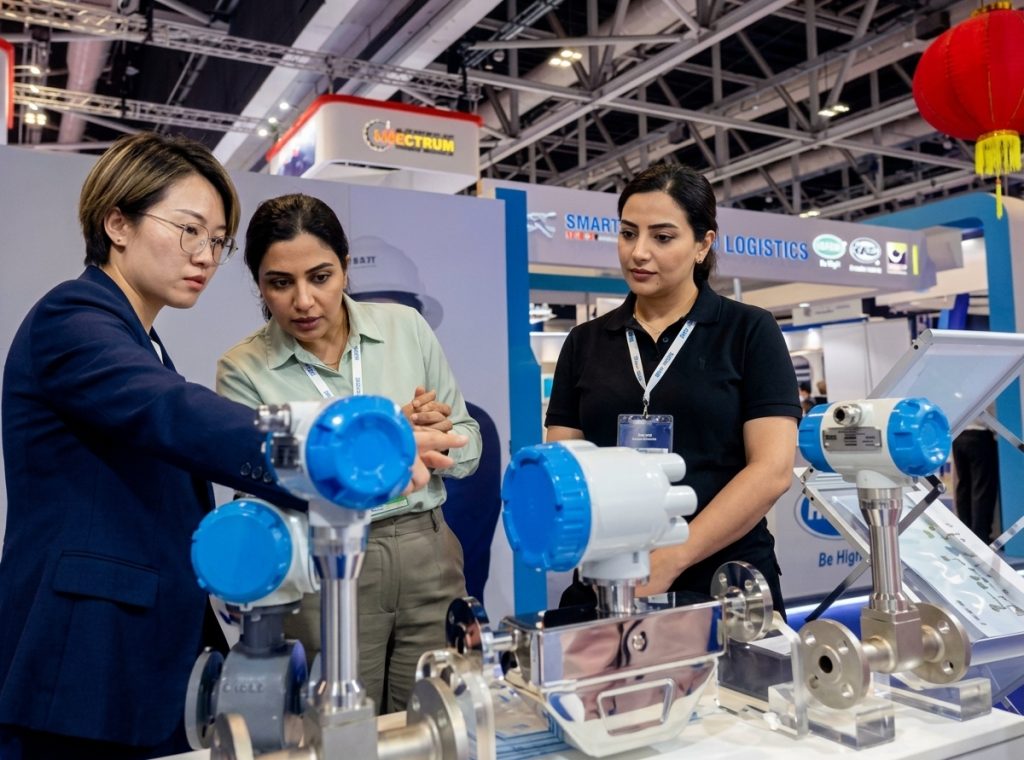
Compressed air is usually treated as a utility, but it should be purchased, distributed and monitored like any other costly process medium. In a large plant, the compressor room may report acceptable total output while individual workshops still experience pressure complaints, unexplained night consumption or rising specific energy use. Without flow measurement at the right boundaries, the maintenance team sees symptoms but cannot identify where the air is going.
For procurement engineers, the difficulty is not finding a device labelled “compressed air flow meter.” The difficult part is writing a specification that produces comparable quotations and a meter that works after installation. Pipe size alone is not enough. The supplier needs to know the gas composition, actual and reference conditions, pressure range, expected flow profile, installation constraints and the purpose of the measurement.
These details matter particularly in Middle East plants. High ambient temperatures, outdoor pipe racks, dust, large utility networks and phased plant expansions can expose weak specifications quickly. A meter selected for a clean indoor compressor room may not be appropriate for an exposed branch line in a cement plant, aluminium smelter or petrochemical complex.
This guide explains how an instrumentation or procurement engineer should define the application, compare technologies and prepare an RFQ that can be technically evaluated before price becomes the deciding factor.
Start with the Measurement Objective
The required performance depends on what the plant intends to do with the data. “Measure compressed air” is not a complete objective. A useful specification begins with one of four common tasks.
Compressor performance monitoring. A meter installed on the main discharge header helps compare delivered air with compressor power, identify deterioration and establish a plant-wide baseline. The line may be large, the flow range broad and shutdown access limited.
Department or production-line sub-metering. Branch meters allocate consumption to workshops, production units or tenants. Repeatability and consistent reference conditions can matter more than laboratory-grade accuracy because the data is used to compare shifts, products or operating areas.
Leak and off-shift monitoring. Night and weekend demand is often a practical indicator of avoidable consumption. The important requirement is not merely maximum capacity; it is stable measurement at the lowest expected flow. A meter sized only for peak production may provide little useful information when the plant is idle.
Internal cost allocation. Where departments are charged for air, the measurement boundary, reference conditions, data retention and verification procedure must be agreed in advance. A general-purpose trending meter should not automatically be treated as a fiscal or custody-transfer instrument.
One plant may require all four functions, but that normally means several meters at different points rather than one device at the compressor outlet.
Actual Flow Is Not the Same as Normalized Flow
This is the most common source of disagreement in compressed air quotations.
A pipeline contains gas at actual operating pressure and temperature. Users, compressor suppliers and energy dashboards often express consumption as normalized or standard volume, such as Nm³/h, Sm³/h or SCFM. These units are meaningful only when the reference temperature and absolute reference pressure are defined. Two suppliers can quote the same numerical range while using different reference conditions.
An RFQ should therefore state:
- required engineering unit;
- reference temperature;
- reference absolute pressure;
- whether humidity is included and, if relevant, the reference humidity;
- expected operating pressure and temperature at the meter;
- whether the value required by the control system is actual volume, mass flow or normalized volume.
Never use gauge pressure in a gas-density calculation without converting it to absolute pressure. A header described as “7 bar” will normally mean 7 bar gauge in plant conversation, but the absolute pressure is roughly one atmosphere higher. Leaving this ambiguous can produce an incorrectly configured totalizer even when the sensor itself is functioning correctly.
Thermal mass flow measurement is attractive for compressed air because it measures mass flow directly and does not normally require a separate pressure and temperature compensation loop for ordinary utility-gas service. It can display a configured normalized volume, but the selected reference conditions still have to match the plant standard.
Build a Realistic Flow Profile Before Selecting the Range
Do not send only the compressor nameplate capacity. The meter sees the behaviour of the network, not the catalogue rating of the compressor.
Ask operations for four values:
- minimum flow during shutdown or non-production hours;
- normal flow during a typical shift;
- maximum sustained production flow;
- short-duration peak flow and its approximate duration.
The minimum value is especially important for leak monitoring. If the expected night flow is below the meter’s practical measuring range, the plant will record zero or unstable values at the exact time it wants to quantify leakage. Conversely, selecting a very small meter to improve low-flow sensitivity can create excessive velocity or pressure loss at peak demand.
For an insertion thermal mass meter, sizing also depends on pipe diameter, internal diameter and the available insertion geometry. The installation should allow the sensing element to reach the specified position in the flow profile. Pipe schedule and wall thickness therefore belong in the RFQ, not just the nominal DN or NPS.
Where the existing pipe is oversized and velocities remain very low, moving the measurement point to a smaller branch may produce better data than buying a higher-priced transmitter for the main header.
Confirm Gas Quality, Moisture and Contamination
“Compressed air” can describe very different media. Instrument air downstream of a dryer is not the same as wet plant air close to a compressor discharge. The RFQ should identify:
- dry or wet air;
- pressure dew point, if known;
- oil-free or oil-lubricated compressor service;
- possible oil aerosol, condensate or particles;
- gas temperature during normal and upset conditions;
- any cleaning agents or chemicals that could reach the line.
Thermal sensors depend on heat transfer between the sensor and the moving gas. Deposits on the sensing element can affect response. A dry, filtered line is generally a more favourable application than a wet header with recurring oil carryover. If liquid slugs are possible, correct the separation and drainage problem rather than expecting the flow meter to compensate for poor utility-system design.
For nitrogen, carbon dioxide or argon networks, do not order a device configured for air and assume that a scaling correction in the PLC will always be sufficient. Gas thermal properties affect calibration. State the exact gas and composition, and ask the supplier to confirm the supported calibration option.
Check the Installation Before Issuing the Purchase Order
Many flow-meter problems are installation problems discovered too late.
Thermal mass meters require a developed and reasonably symmetrical velocity profile. Elbows, control valves, partially open isolation valves, reducers, filters and compressor pulsation can distort the profile. The required upstream and downstream straight lengths depend on the disturbance and meter design; they should be checked against the selected manufacturer’s installation instructions, not copied from a generic rule.
Before requesting a quotation, obtain a marked-up isometric or at least clear photographs showing:
- upstream and downstream fittings;
- available straight-pipe length;
- pipe orientation;
- access platform and insertion clearance;
- proposed isolation arrangement;
- cable route and local display visibility;
- whether the pipe can be depressurized.
If the line cannot be shut down, an insertion meter with a suitable process connection and extraction arrangement may be preferred. However, “hot-tap capable” should never be treated as permission to remove a sensor under pressure without an approved procedure. The pressure rating of the connection, insertion assembly and isolation valve must match the line, and removal should be covered by the plant’s mechanical and safety rules.
Outdoor installations in Gulf climates also require attention to solar loading. The regional air temperature may be within the transmitter’s stated ambient range while the enclosure surface becomes considerably hotter in direct sun. A sunshade, suitable mounting position and remote installation should be considered where necessary. Confirm enclosure rating, cable glands, UV resistance and dust protection as a complete installation, not only as a transmitter datasheet value.
Select Outputs for the Data Architecture, Not for Habit
For a standalone local indicator, a display and pulse output may be sufficient. For energy management, the plant will usually need at least flow rate and totalized consumption in a historian, energy-management platform or DCS.
A typical specification may call for 4–20 mA with HART for instantaneous flow plus pulse or digital communication for totalization. Before choosing, confirm:
- available DCS or PLC input type;
- whether the pulse input can handle the expected frequency;
- required totalizer resolution;
- communication protocol and device-integration files;
- fail-state behaviour;
- whether local totalization must continue during a control-system outage;
- how data will be time-stamped and retained.
Do not buy a communication option that the control system cannot use. Equally, do not reduce a useful multi-variable instrument to a single analogue signal if the project needs temperature, totalized flow and diagnostics.
The FUGUI Automation flow measurement portfolio includes technologies for gases, steam and liquids. For compressed-air sub-metering on large lines, the Endress+Hauser Proline t-mass B 150 is an insertion thermal mass meter intended for utility gases. According to the manufacturer’s published configuration range, it is offered for DN 80 to DN 1500 lines, with a maximum process pressure of 20 bar gauge and medium temperatures from −40 to +100°C. Exact measuring range, calibration uncertainty, approvals and outputs depend on the selected order code and should be verified before purchase.
Where the project also needs header-pressure trending, low-pressure alarm analysis or compressor-control diagnostics, specify a separate device from the pressure measurement range. Flow and pressure trends viewed together are more useful than either variable alone: rising flow with falling header pressure points to a different operating problem than stable flow with a sudden pressure drop.
Middle East Project Requirements That Belong in the Datasheet
Regional conditions should be converted into measurable requirements rather than covered by the phrase “suitable for Middle East service.”
For outdoor or semi-outdoor installations, state the design ambient-temperature range, solar exposure, humidity, dust conditions and proximity to the coast. Offshore facilities and coastal desalination or utility plants may require additional corrosion protection. Hazardous-area projects must identify the area classification, gas group, temperature class, protection concept and the certification accepted by the end user. Writing only “Ex-proof” is inadequate.
EPC projects should also define documentation at the RFQ stage. Typical requirements include:
- manufacturer datasheet for the quoted configuration;
- complete model and order code;
- dimensional drawing and process-connection detail;
- hazardous-area certificate where applicable;
- calibration certificate and stated calibration conditions;
- material certificates if contractually required;
- country of origin;
- inspection and test plan requirements;
- recommended spare parts;
- operating and installation manuals;
- document language and final dossier format.
If a certificate is mandatory, require the supplier to identify the exact certificate and order-code option in the quotation. A product family may hold several approvals, but that does not mean every individual configuration carries all of them.
How to Compare Supplier Quotations
Procurement teams often receive one low price, one technically detailed offer and one quotation that simply repeats the RFQ title. A commercial comparison made before technical normalization is likely to select the wrong device.
Use a bid tabulation with separate columns for:
| Evaluation item | What must be compared |
|---|---|
| Measuring basis | Mass, actual volume or normalized volume |
| Reference conditions | Temperature, absolute pressure and humidity basis |
| Gas calibration | Air or the stated utility gas |
| Flow range | Minimum, normal, maximum and overload condition |
| Performance | Accuracy statement, repeatability and low-flow capability |
| Mechanical fit | Pipe size, schedule, insertion length and connection |
| Process limits | Pressure, gas temperature and ambient temperature |
| Installation | Straight-run requirement and disturbance type |
| Electrical | Supply, outputs, communication and cable entry |
| Environment | IP rating, hazardous-area approval and sun exposure |
| Documentation | Calibration, certificates, drawings and manuals |
| Supply | Lead time, warranty, inspection and spare availability |
Any deviation should be written explicitly. “Complies” is not enough when the quotation does not show the selected model code and configuration.
A Procurement-Ready RFQ Checklist
The following information is sufficient for a competent supplier to begin technical selection:
Service and purpose
- compressor main header, plant header or department branch;
- monitoring, leak detection, allocation or control;
- permanent installation or temporary survey.
Process data
- gas and composition;
- dry/wet condition and pressure dew point;
- minimum, normal and maximum flow;
- operating and design pressure;
- operating and design temperature;
- required units and reference conditions.
Pipe and installation
- DN/NPS, schedule, material and actual internal diameter;
- horizontal, vertical up-flow or vertical down-flow;
- available upstream and downstream straight length;
- nearby elbows, valves, reducers or filters;
- process connection and pressure rating;
- shutdown availability and hot-tap requirement;
- indoor/outdoor location and mounting access.
Electrical and control
- power supply;
- required outputs and protocol;
- local display requirement;
- hazardous-area classification;
- cable-entry standard;
- DCS, PLC or energy-platform interface.
Commercial and documentation
- quantity and required delivery date;
- destination and Incoterm;
- inspection requirement;
- calibration and material certificates;
- approved manufacturer list;
- warranty and required spares.
Attach a pipe drawing and site photographs whenever possible. Ten minutes spent documenting the installation can prevent weeks of clarification after the order is placed.
Final Recommendation
A useful compressed-air metering system begins with a defined measurement boundary and a realistic flow profile. It does not begin with a brand name. For most sub-metering and energy-monitoring applications, an insertion thermal mass meter offers a practical combination of direct mass measurement, low pressure loss and installation flexibility. Its suitability still depends on gas quality, low-flow requirement, pipe geometry, process limits and the selected order code.
For Middle East projects, add ambient exposure, dust, solar loading, hazardous-area requirements and documentation obligations to the datasheet before issuing the RFQ. Then compare quotations on the same normalized-flow basis and confirm every mandatory option against the full model code.
FUGUI Automation can review an instrument datasheet, pipe information and required measurement range before quotation. Send the gas composition, reference conditions, flow profile, pipe schedule, installation drawing and certification requirements through the technical inquiry page. The objective is not simply to quote a meter that fits the pipe; it is to supply a configuration that produces usable data after commissioning.